Discounts, bundles and free gifts: what each offer does to CAC
A discount brings the cheapest orders and leaves the least of each one. Bundles and gifts over a threshold usually leave more, so we test offers on Meta and pick the winner on contribution after ad costs.
On this page
Black Friday is on 27 November this year and Cyber Monday on the 30th, so this is the week to settle your offer. The usual choice is a sitewide percentage, often the same one as last year. It’s easy to run and it brings in orders. It also takes margin from every one of them, including the orders you’d have had at full price.
Deeper isn’t the safe bet it looks. In Klaviyo’s data from 10,000 brands, the average discount across Black Friday and Cyber Monday fell last year, from about 30% to 26%, and the brands with the smallest discounts grew fastest. Here’s what each common offer does to cost per purchase, order value, margin and repeat buying, how we test offers on Meta, and what we’d do with the time left.
The short version
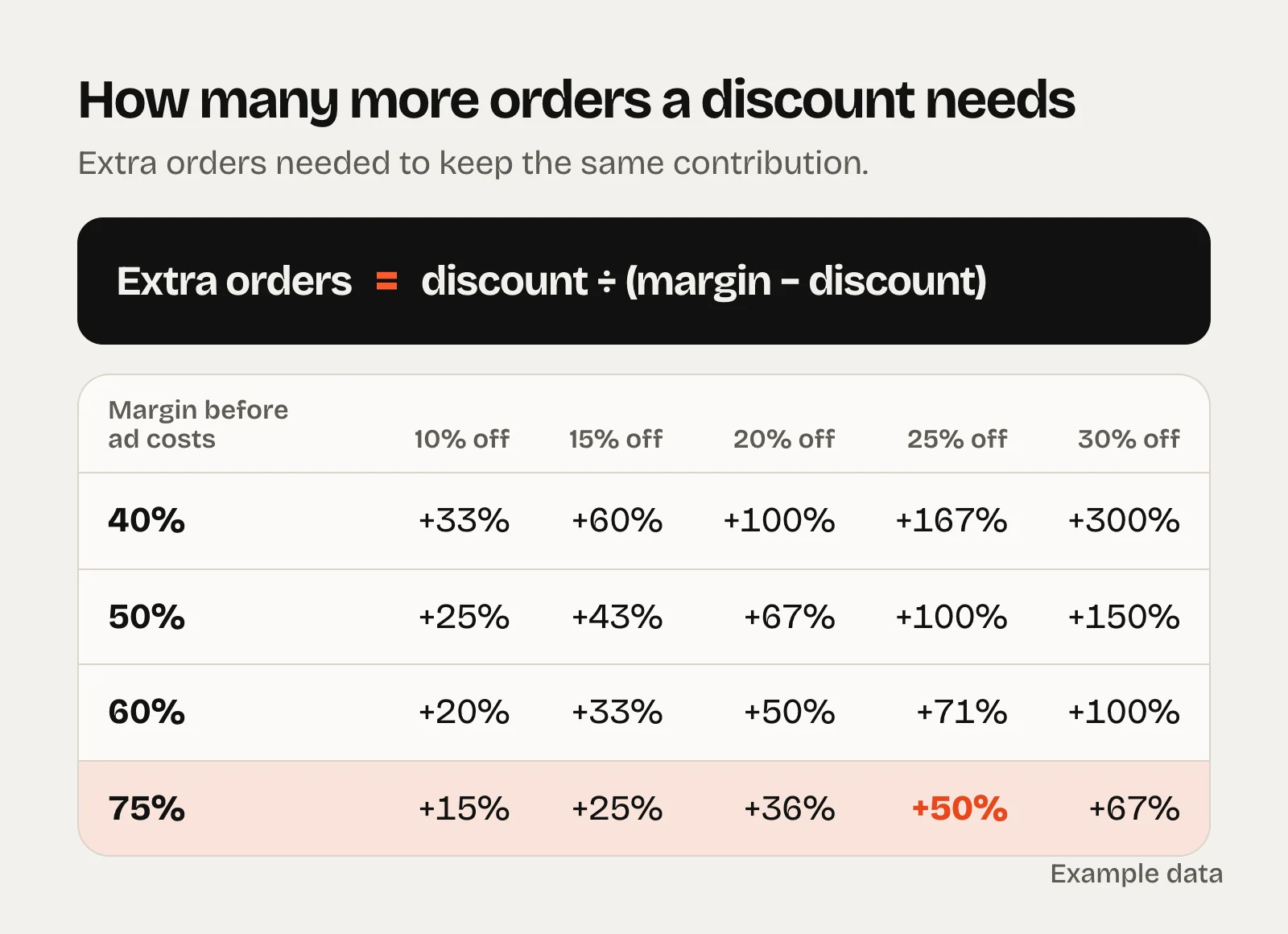
- Before you run a discount, work out how many extra orders it needs: discount ÷ (margin − discount). At a 75% margin, 25% off needs 50% more orders just to stand still.
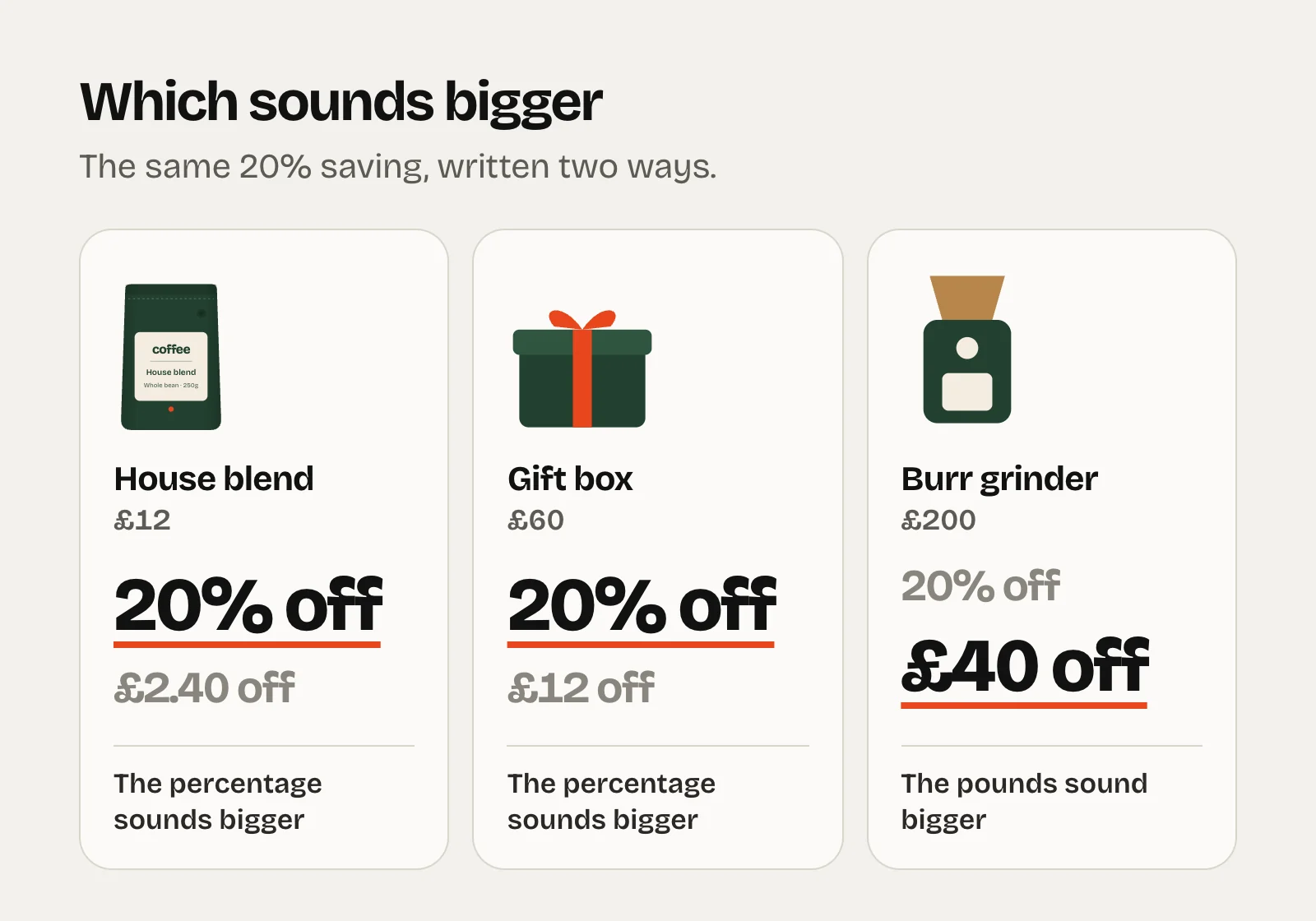
- Percentages sound bigger on products under £100, and pounds sound bigger above it.
- Bundles, and gifts or free delivery over a threshold, raise order value, so they often leave more per order than a deeper discount.
- Test offers in separate ad sets with the same ad, and pick the winner on contribution after ad costs, not ROAS.
What an offer changes
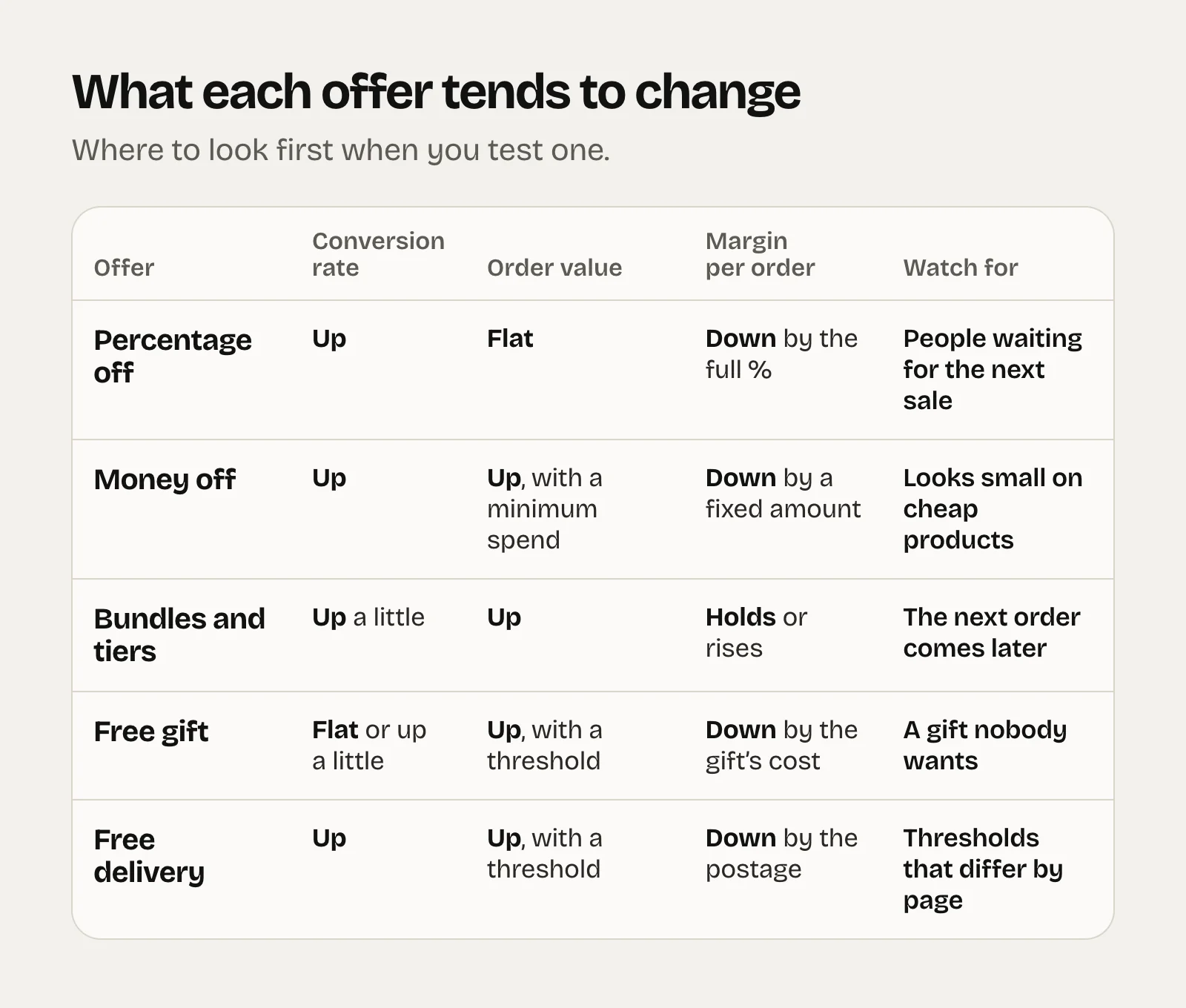
Every offer moves five numbers at once: conversion rate, cost per purchase, order value, margin per order and how often customers come back. Cost per purchase falls when more of the same clicks turn into orders, which is why discounts look so good in Ads Manager. ROAS reflects the first three. It can’t see your product costs, the gift or the postage you paid for, or whether the customer comes back.
1. Percentage off
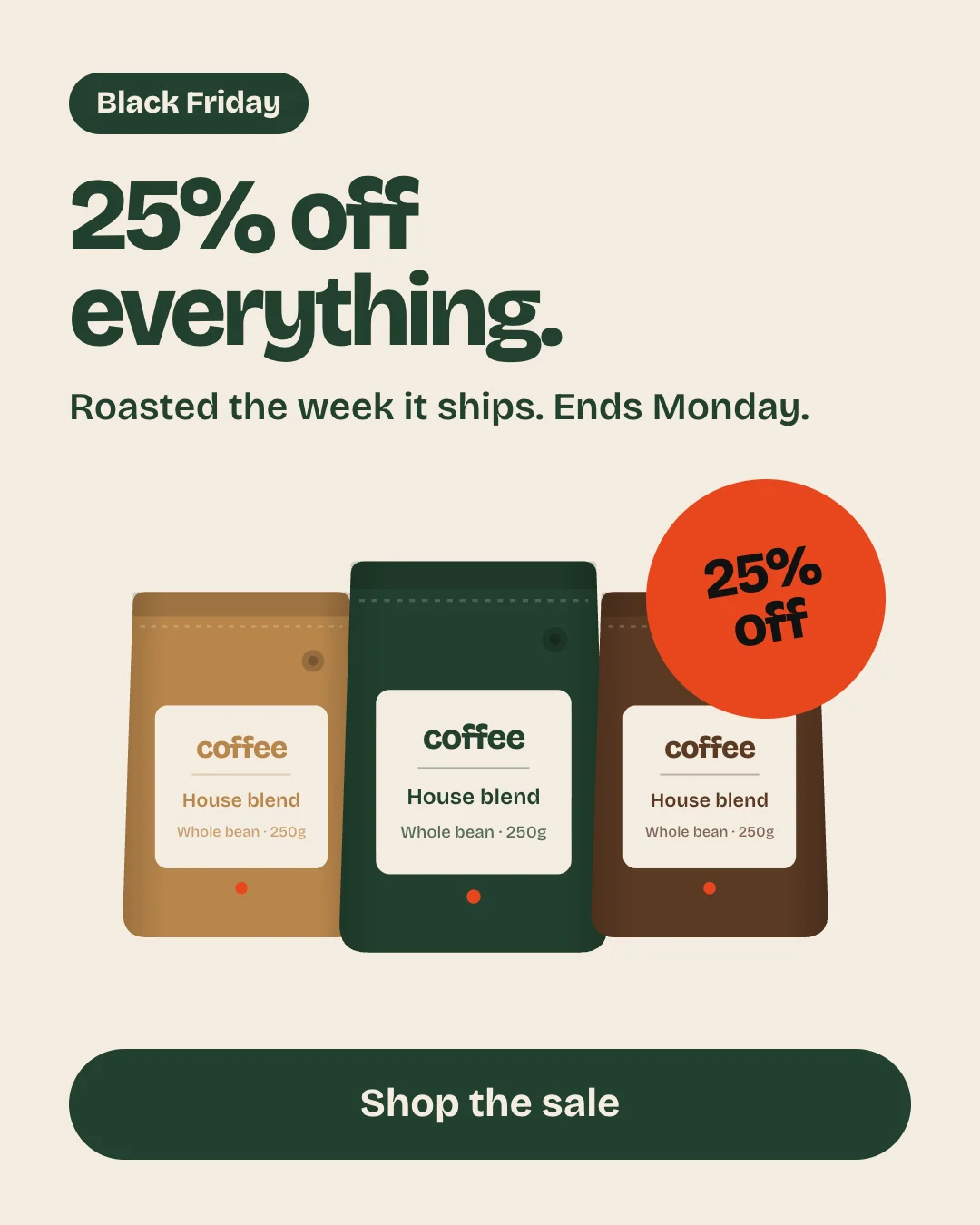
The simplest offer to say and to run, and usually the biggest lift in conversion rate. It works best on products under £100, where a percentage sounds bigger than the same saving in pounds. Jonah Berger calls this the rule of 100, and a 1998 pricing study by Chen, Monroe and Lou found the same split between cheaper and pricier products.
The cost is that every order gets the discount, including the ones you’d have had at full price. So we work out the break-even first. The extra orders a discount needs to make the same contribution are discount ÷ (margin − discount), using your margin before ad costs. With a 75% margin, 25% off needs 50% more orders. With a 50% margin, it needs twice as many.
Repeat buying is the cost that shows up last. A study of a newspaper and an online grocer found that the deeper the discount that first brought customers in, the less often they bought again. In Tresl’s data from 106 Shopify stores, 14% of new customers from Black Friday 2024 ordered again within six months, against 19% of new customers who arrived at other times. Regular discounts also lower the price people expect to pay next time.
So we use percentages on a hero product, for a set window, aimed at new customers.
2. Money off
The same saving, written in pounds. Above £100 it sounds bigger than the percentage, so £40 off a £200 grinder lands harder than 20% off.
Money off also works with a minimum spend, like £10 off orders over £50. The minimum lifts order value, and because the saving is fixed, it costs less as a share of a bigger basket. Set the minimum just above your average order, so a typical customer adds one thing to qualify.
3. Bundles and tiers
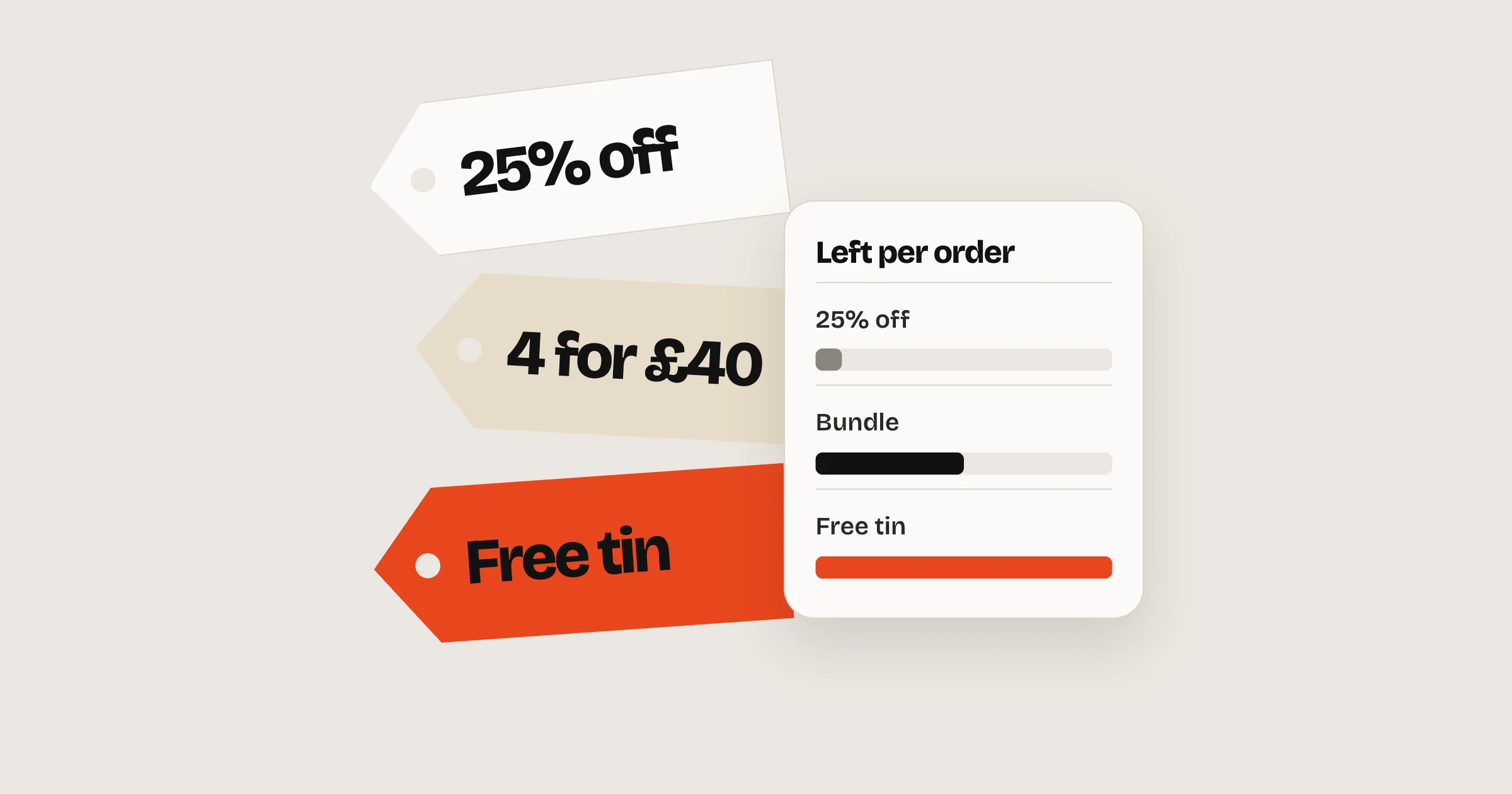
A bundle raises order value without changing the price of a single item. Tiers do the same in steps: 2, 4 or 8 bags, with the price per bag falling at each one. Each step gives a bigger saving, and the extra bags more than pay for it, so what’s left of each order goes up.
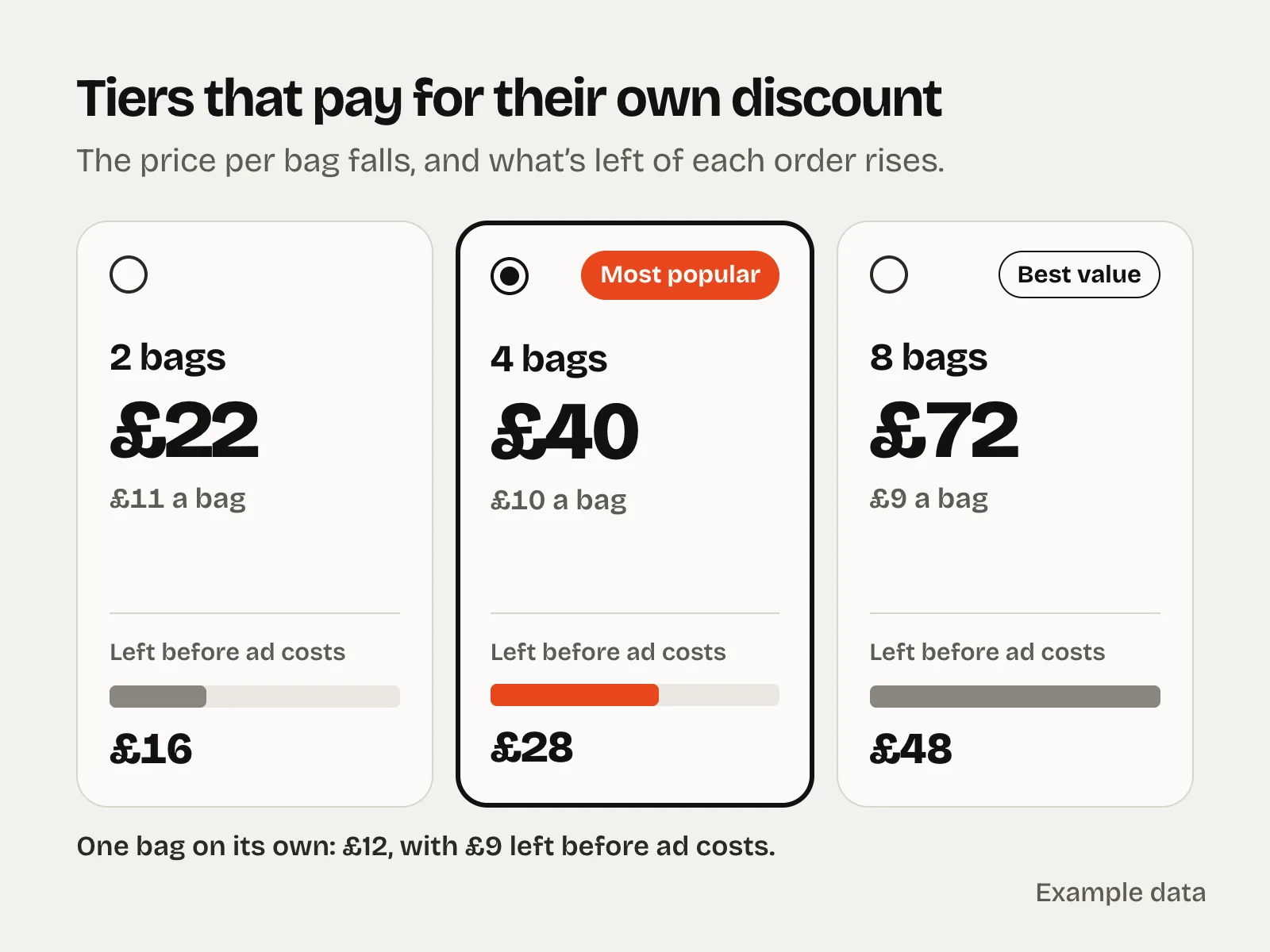
Preselect the tier you want most people on, usually the middle one. People who aren’t sure lean towards the middle option, which Itamar Simonson described as the compromise effect in 1989. On a pet supplement account we run, making the three-month pack the default lifted order value by about a quarter. Conversion rate dipped, and return on ad spend still went up.
The cost is timing. Customers who stock up come back later, and studies of supermarket promotions find sales dip after a promotion ends for the same reason. Read repeat rate on bundle buyers over a longer window than usual.
4. Free gifts
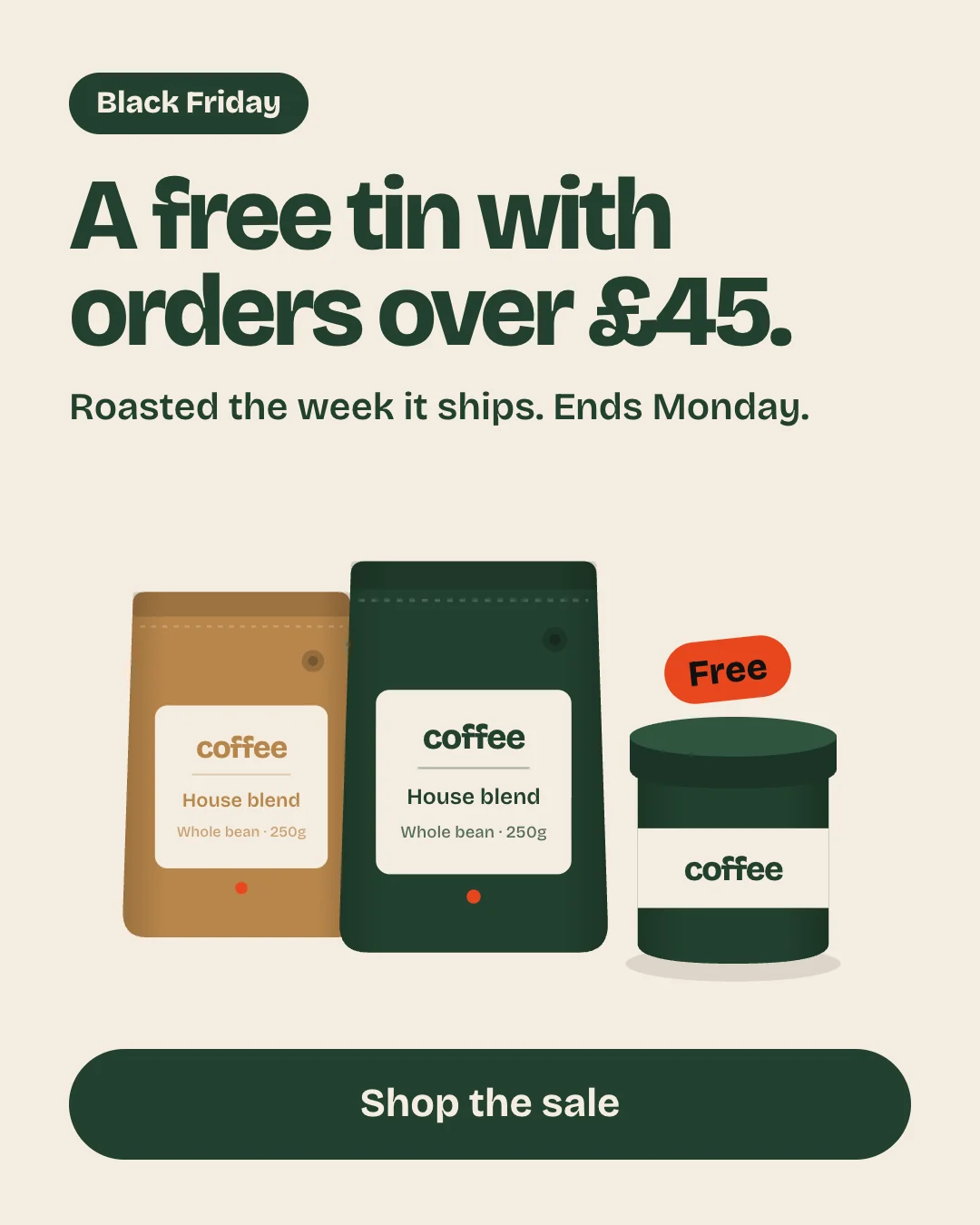
A gift costs you what you paid for it, not what it sells for. A tin the customer values at £10 might cost you £2, where £10 off costs you the full £10. Put the gift behind a threshold, such as orders over £45, and it lifts order value as well.
Choose it carefully. When a study labelled one item in a pair as free, people would then pay less for either item on its own, while the price they’d pay for the pair held. Explaining that the pairing was a way to try the free item softened the effect. So we gift accessories, limited editions or a sample of something new, and keep the best-seller out of it.
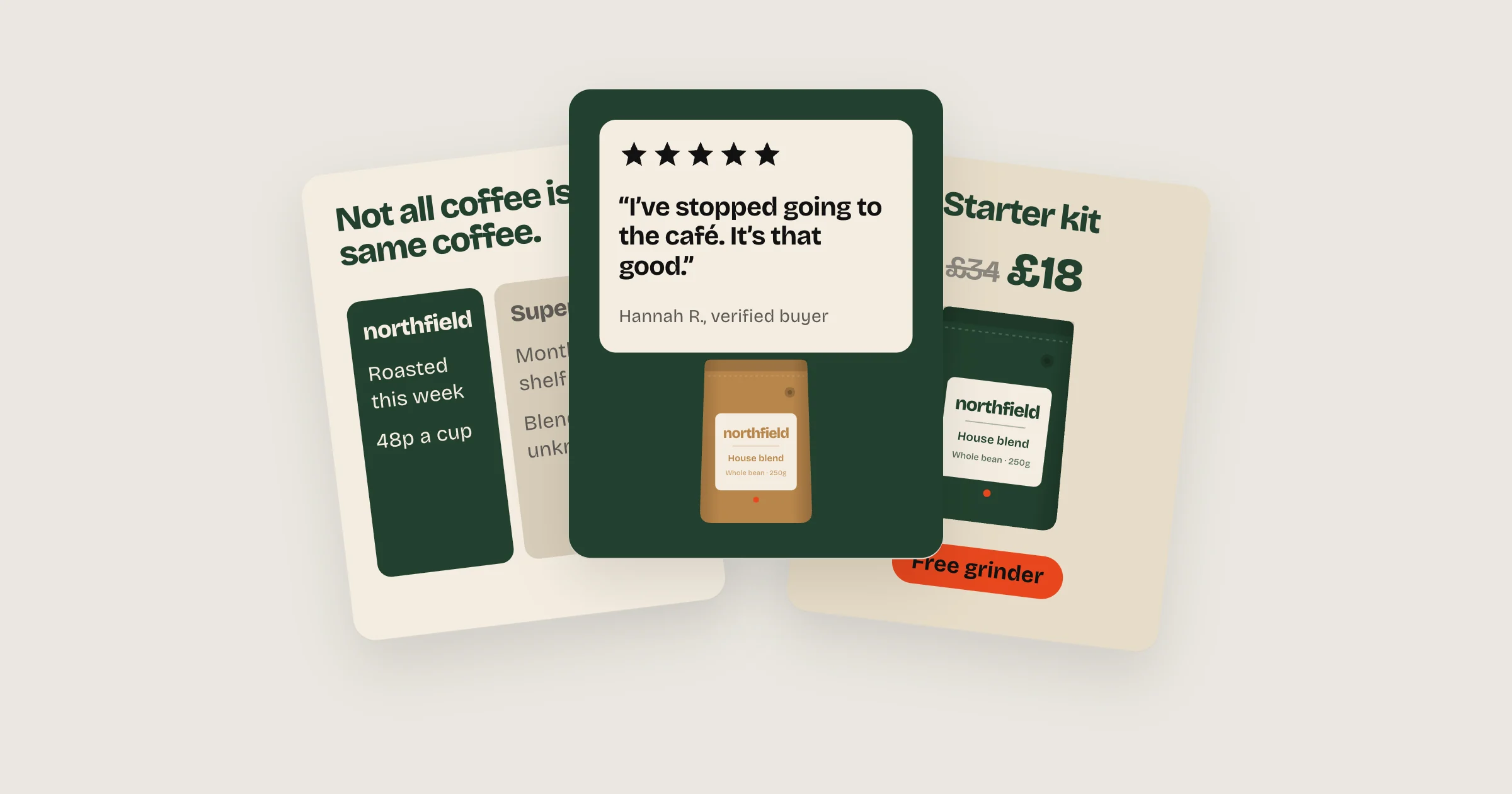
Show the gift in the ad, next to the product, and keep everything else the same when you test it against a discount.
5. Free delivery
Free has a pull of its own. People treat a price of zero differently from a small price, as Shampanier, Mazar and Ariely showed in 2007, and delivery charges are where a lot of baskets stop. Among US shoppers who were ready to buy, extra costs such as delivery, tax and fees are the most common reason Baymard finds for abandoning an order, at 40%.
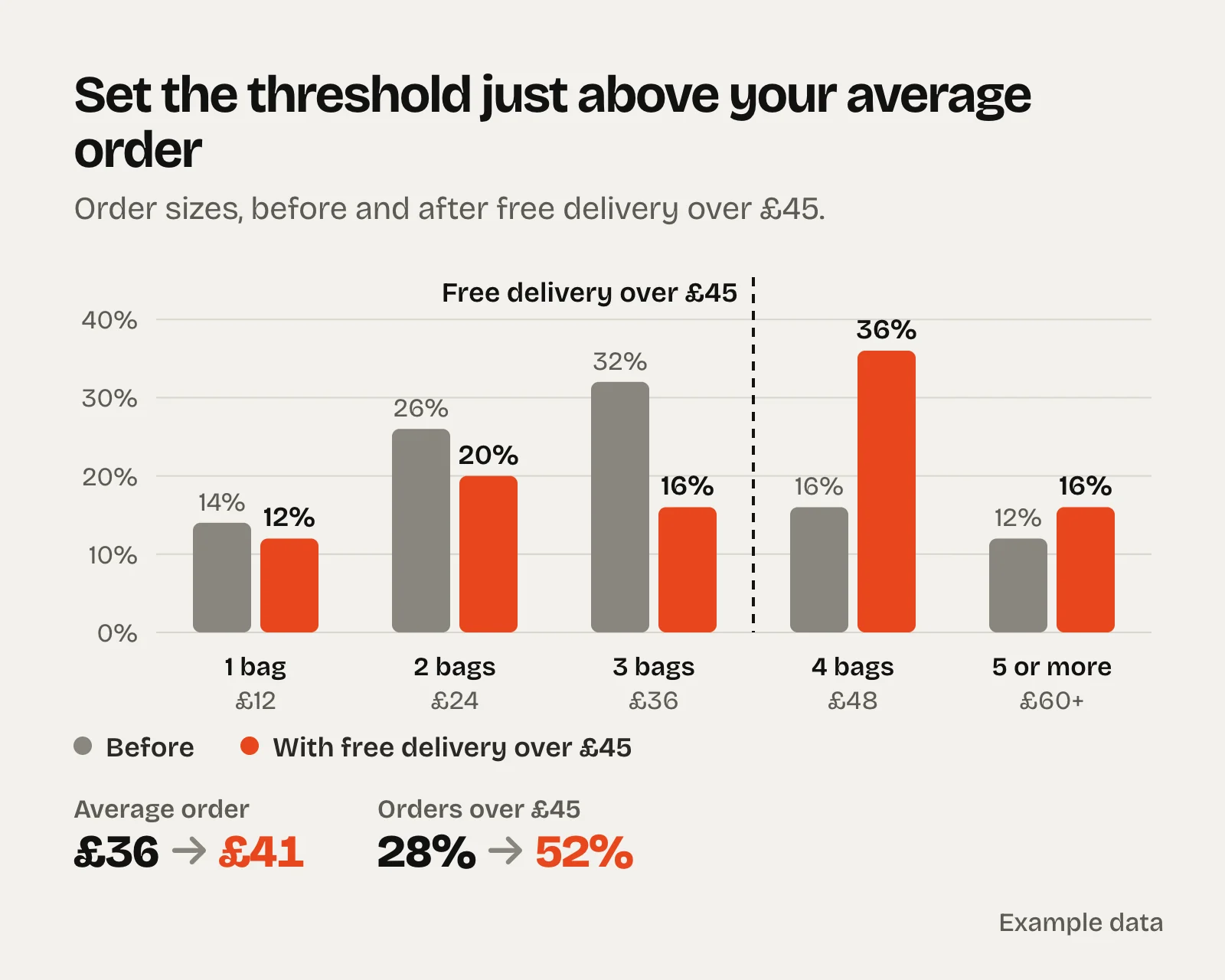
We almost always put it behind a threshold. In a study of an online retailer that tested many delivery charges, free delivery with and without a minimum order both brought in extra sales, but the lost delivery income made them unprofitable. A threshold just above your average order means the typical customer adds an item, and that item pays for the postage.
Use one threshold everywhere. Both accounts we audited this month showed different free-delivery amounts depending on where you looked. In one, the ads, the banner and the basket each gave a different number. Meta now says ad quality covers what happens after the click, drawing on more than 200 million customer survey responses a year about things like unexpected charges and whether people felt misled. So a mismatch can cost you twice, at checkout and in the auction.
Where the money goes
Here’s how three offers compare for an example coffee brand. A bag sells for £12 and costs £3, so the margin before ad costs is 75%. The ad cost per order comes from the test further down.
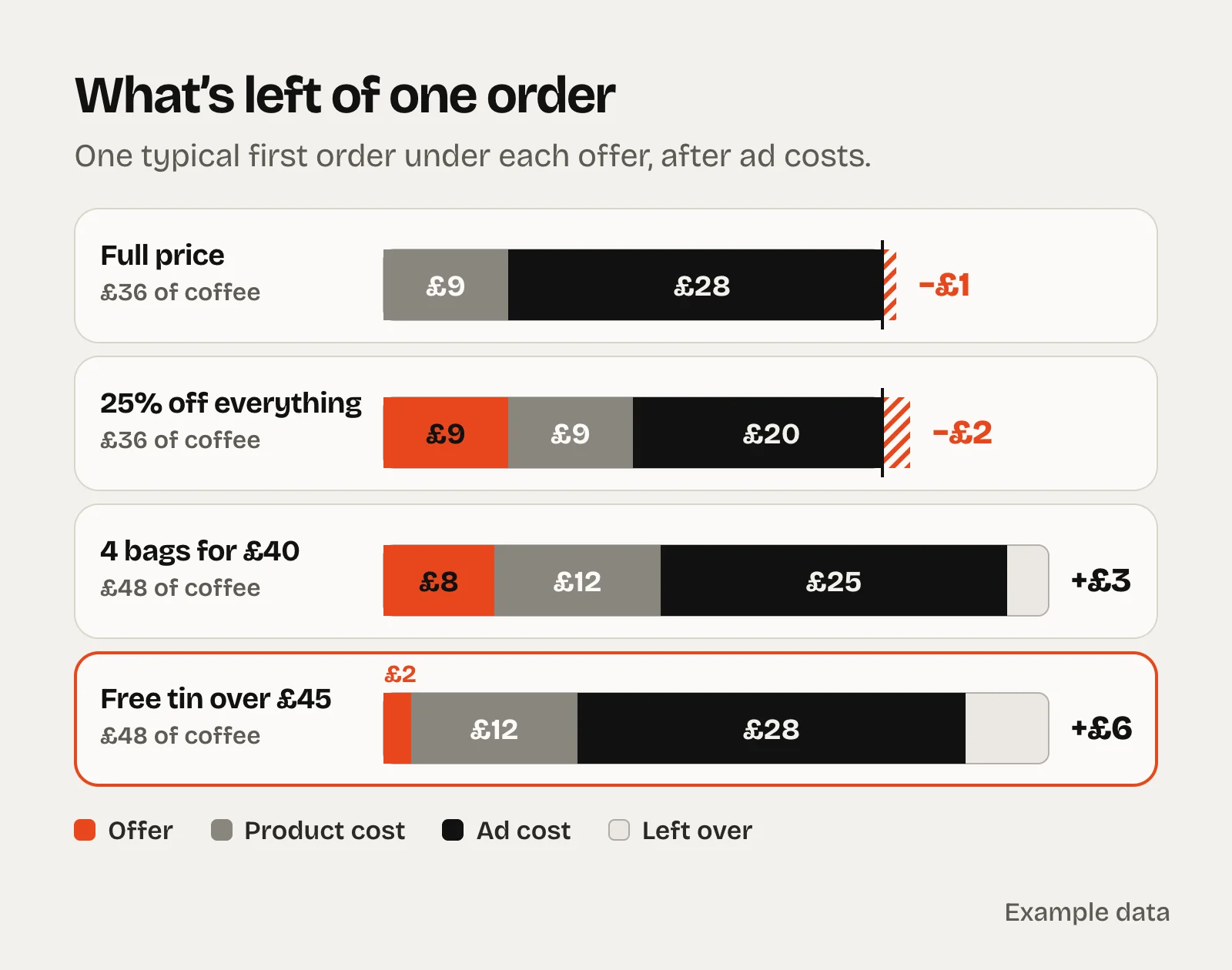
25% off brings the cheapest orders and keeps the least of each one. The bundle and the gift cost more per purchase than the discount and leave more behind, because the customer buys a fourth bag.
How we test offers on Meta
An offer test is a creative test with a different page and checkout behind each version. We keep everything else the same: one ad with only the offer changed in the image, headline and text, the same audience, the same optimisation event and the same budget. That follows Meta’s advice to test one variable at a time.
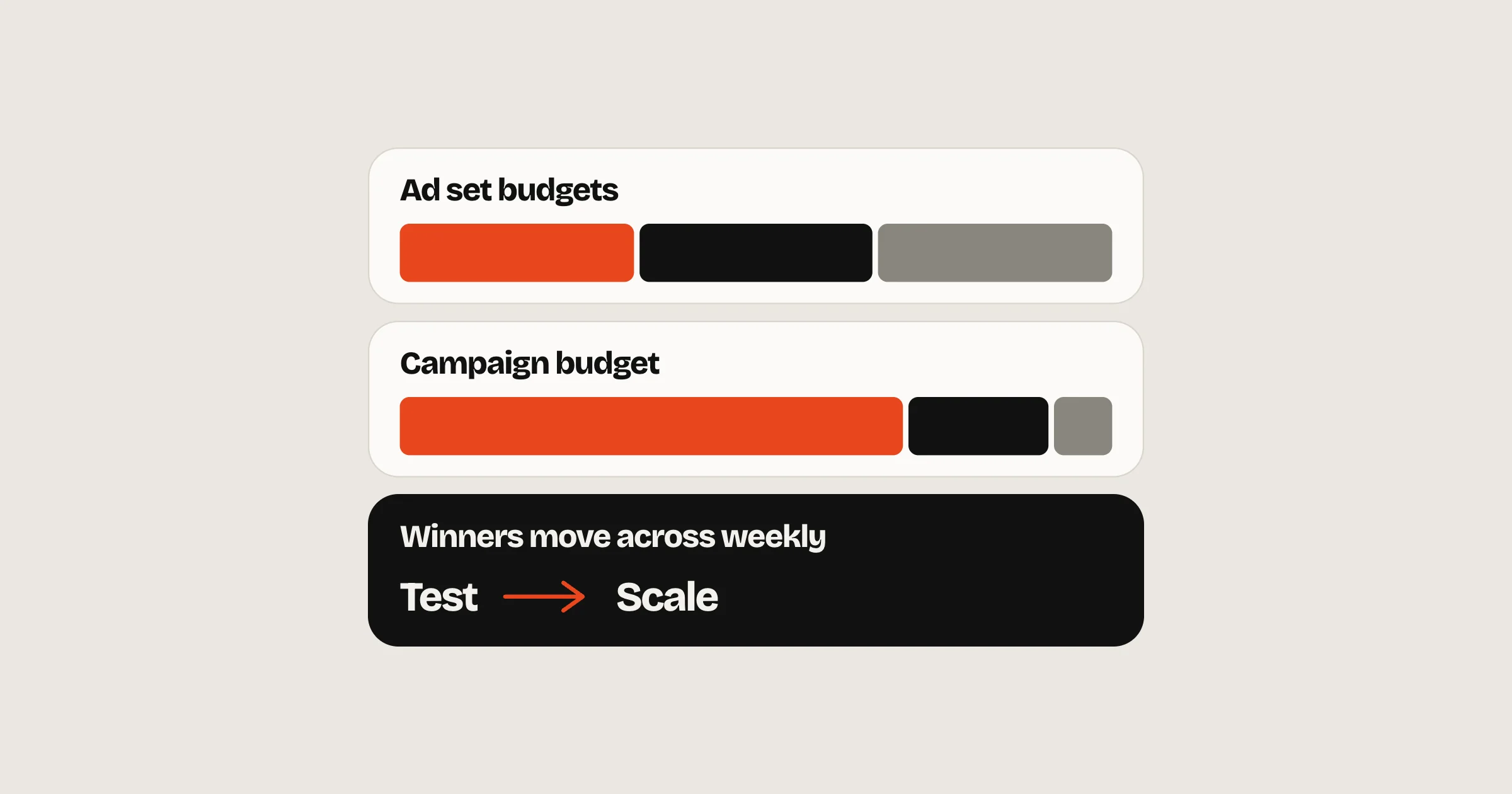
Use Meta’s A/B test when you can. It splits the audience so nobody sees two versions, which matters for offers, because each person should only see one price. For three or four offers, we run a test campaign on ad set budgets with one offer per ad set, the same setup we use for testing concepts, and exclude existing customers. Exclusions never catch everyone, so we still check each offer’s share of new customers in the store’s own data.
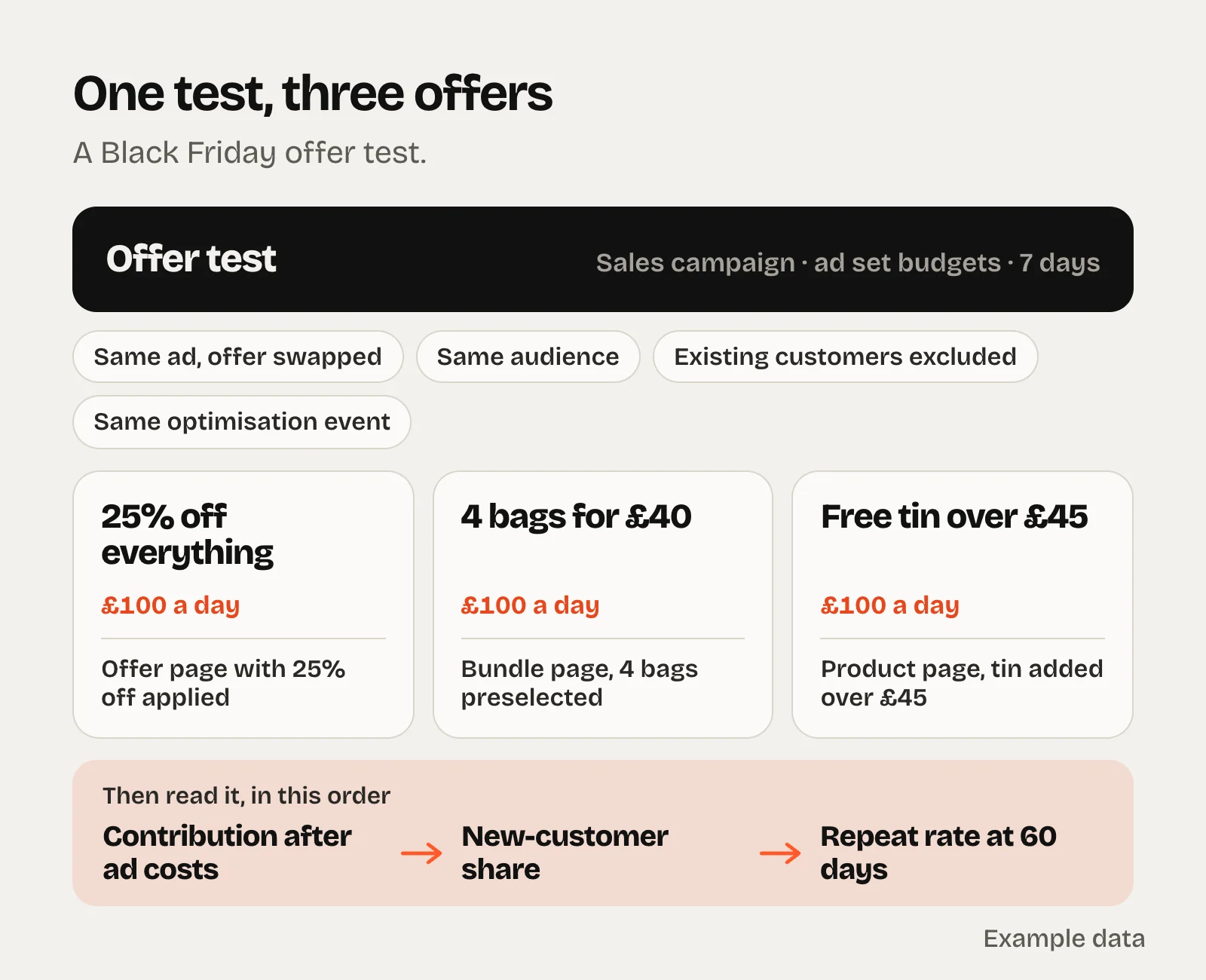
Each offer needs its own landing page, or a link that applies it. On Shopify, a shareable discount link applies the code at checkout and can land people on the product page. Check that Meta isn’t adding offers of its own as well: it can pull discounts it finds on your site into your ads, and the setting is in Commerce Manager under Offer merchandising.
Give each offer at least seven days and around 20 purchases, then judge it on contribution after ad costs: orders × (order value − product cost − offer cost) − spend. ROAS can mislead here, because your break-even ROAS rises when you discount. At a 75% margin, 25% off moves it from 1.33 to 1.5.
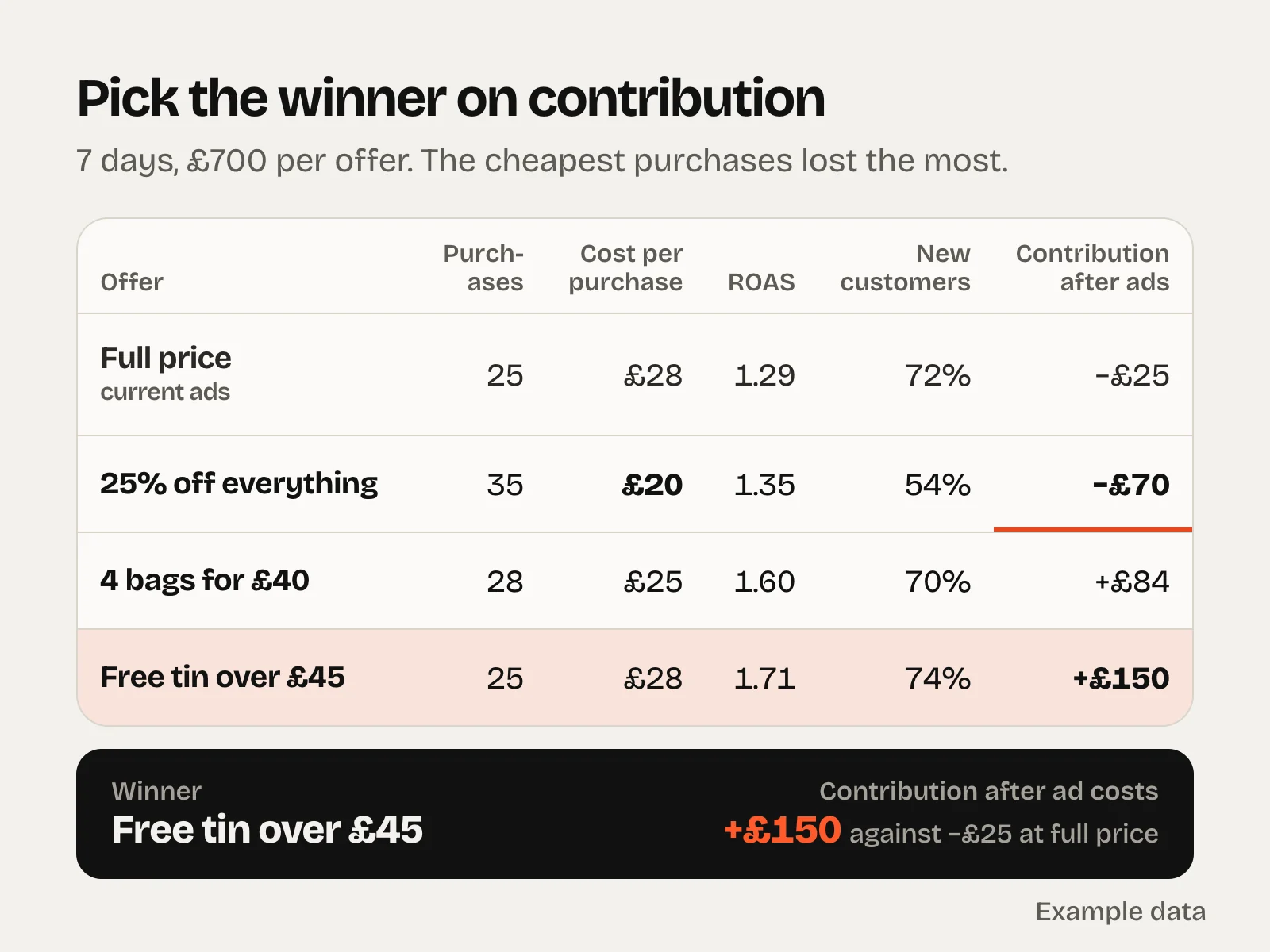
In this test, 25% off beat full price on ROAS and lost £45 more. The tin won on contribution and brought the highest share of new customers. We check repeat rate on each group at 60 days before deciding how deep to go next year.
What we’d do before Black Friday
Test now. Last year, Meta CPMs for the median brand on Lebesgue stayed within 7% of their September level until the week of 10 November, then ran 59% above it in Black Friday week. Purchases per click rose 48% that week, so cost per purchase still fell 20%. A test this week costs less than one in Black Friday week and still tells you what to lead with.
Keep the ad sets you’ll use for the sale running now, so they’re through learning before the peak. Meta’s holiday advice was to have ads live by mid-October. On the day the sale starts, add every new ad and offer in one sitting. Meta’s peak-season post puts it as one learning phase instead of five.
Choose between sitewide and a hero product on margin. A sitewide discount pays out on every order, including the ones your regulars would have placed anyway, and in field tests at a catalogue retailer, deeper discounts lowered what established customers bought later. An offer on one or two hero products limits the cost to what you’re advertising and makes the ad easier to write.
Give your email and SMS list early access a few days before the ads go live. Klaviyo’s recap of last year credits early access and VIP offers with helping brands get ahead of the discount surge.
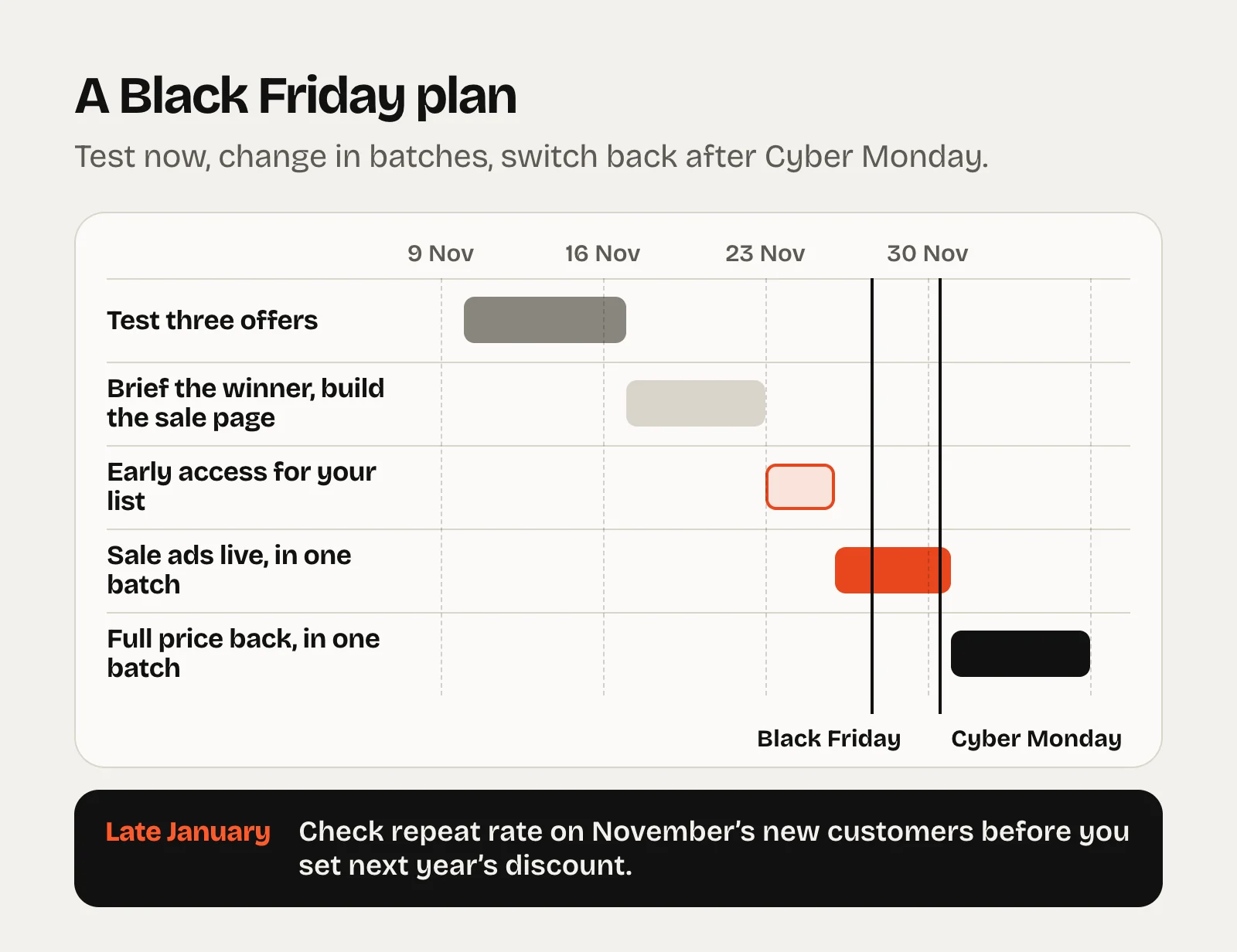
Plan the hangover too. Go back to full price on 1 December in one batch, with the offer ads off and the full-price ads back on the same morning. Expect a slower week: some of the sale was people stocking up, and CPMs stay high for a few days after Cyber Monday. Last year they were still 48% above September the day after and 20% above two days later. Judge December against December, not against Black Friday week.
How to choose your offer
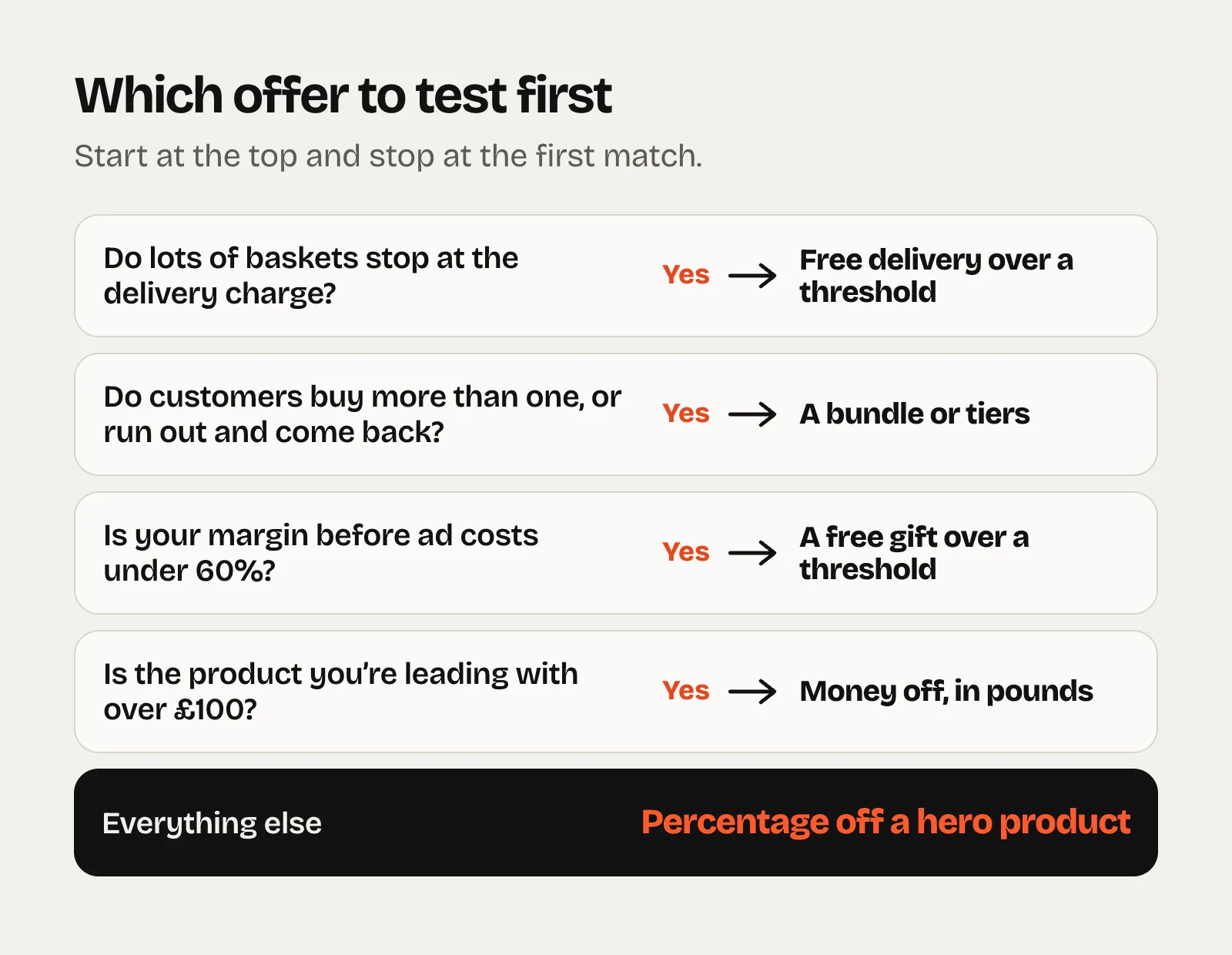
Four habits undo most of this:
- Different offers in different places. The ad, the banner, the pop-up and the basket should all say the same thing.
- Picking the winner on cost per purchase. The deepest discount usually wins on it.
- Discounting sitewide by habit. Work out the extra orders it needs before you commit.
- Leaving sale ads running into December. Switch back the morning after Cyber Monday, in one batch.
If you want one thing to try this week, run the break-even sum on last year’s Black Friday offer. If it needed more extra orders than it brought, test a bundle or a gift over a threshold against it before the 27th.