CBO vs ABO in 2026: how we structure testing and scaling
Use a campaign budget when you’re happy for Meta to choose the split, and ad set budgets when a set amount has to reach each ad set. Most ecom accounts need both, in separate campaigns.
On this page
- What each setting is called now
- How each one spends the same money
- Work out how many ad sets you can afford
- When we use a campaign budget
- When we use ad set budgets
- How we test new concepts
- The structure we start from
- When a test graduates
- Scaling without resetting learning
- Where Advantage+ fits
- Which one to use
Should the budget sit on the campaign or on the ad set? It’s one of the first questions brands ask about their Meta account, and the argument is years old. Facebook planned to make campaign budgets compulsory from 2019, then dropped the plan, so CBO and ABO are both still here.
A lot has changed around them. There’s now a third setting, budgets can swing further from day to day, and sales campaigns start with the campaign budget switched on. We use both, for different jobs, usually in separate campaigns. Here’s how each one spends your money, how we choose, and the structure we start from.
The short version
- Use a campaign budget when your ad sets share a goal and you’re happy for Meta to choose the split. It suits scaling.
- Use ad set budgets when a set amount has to reach each ad set. It suits testing and ad sets that differ in value.
- Before either, work out how many ad sets your budget can feed. Most accounts run too many.
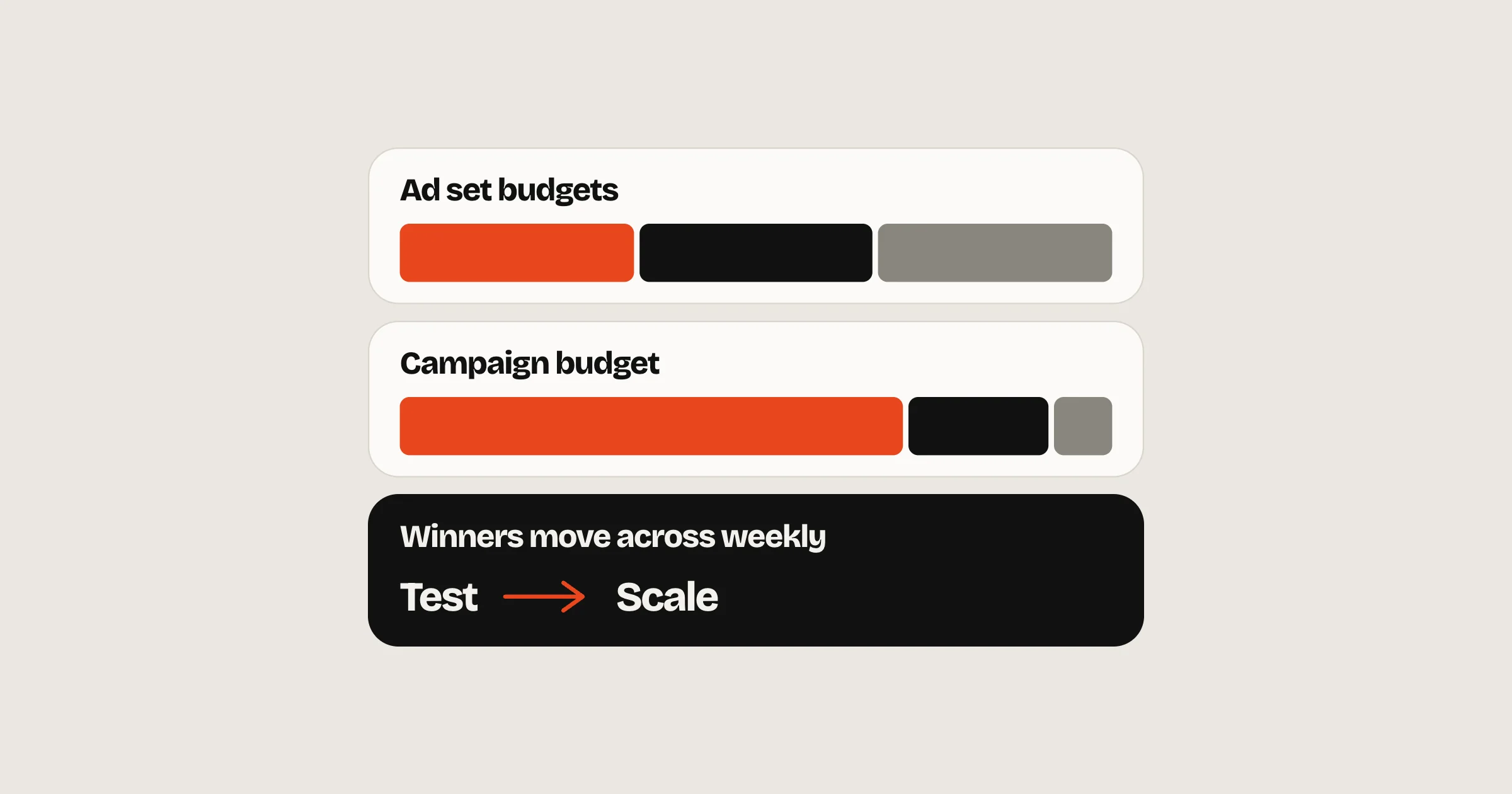
- Test in one campaign, scale in another, and move winners across in weekly batches.
What each setting is called now
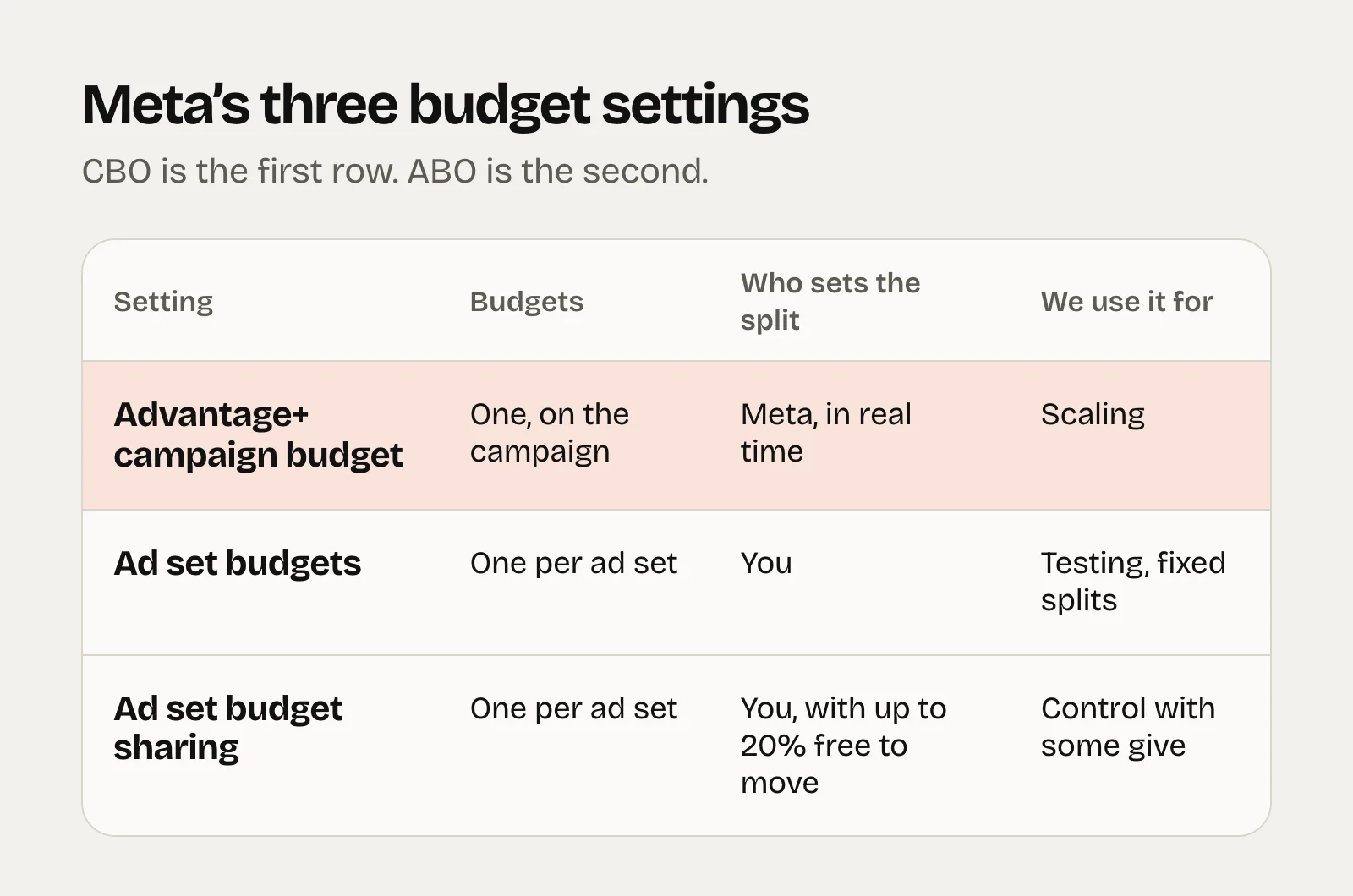
You won’t find “CBO” in Ads Manager any more. Meta calls it Advantage+ campaign budget, and it’s on by default in sales, leads and app promotion campaigns. “ABO” is plain ad set budgets, which you get by switching that toggle off. The third option, ad set budget sharing, sits between them: each ad set keeps its own budget, and up to 20% of it can move to other ad sets when Meta sees better opportunities.
How each one spends the same money
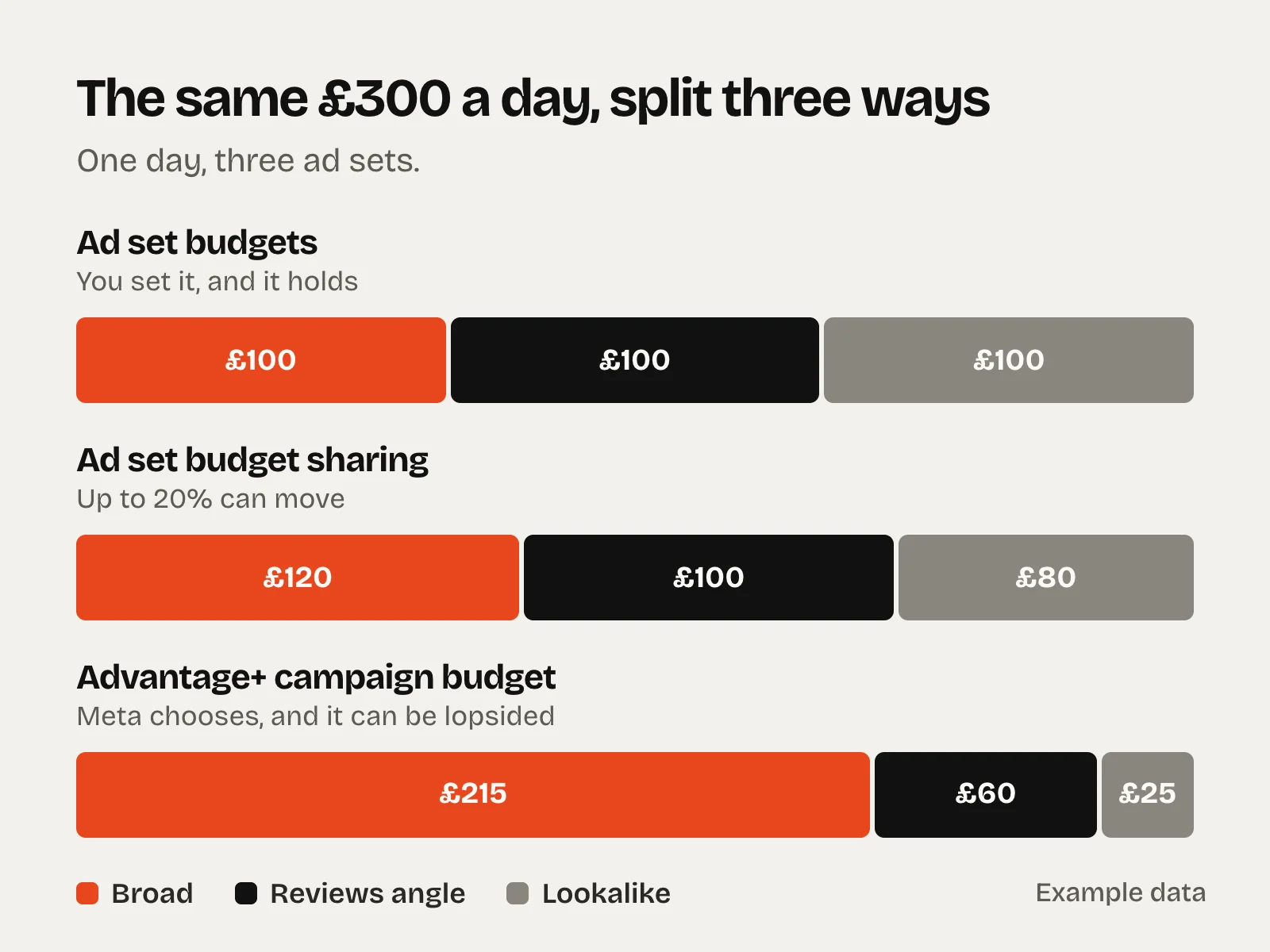
A campaign budget has no duty to be even. Meta says plainly that with two active ad sets it might spend most of the budget on one, and that where audiences differ a lot in size, the largest will probably get the most. Ad set budgets hold the split you set. Sharing lets it drift a little.
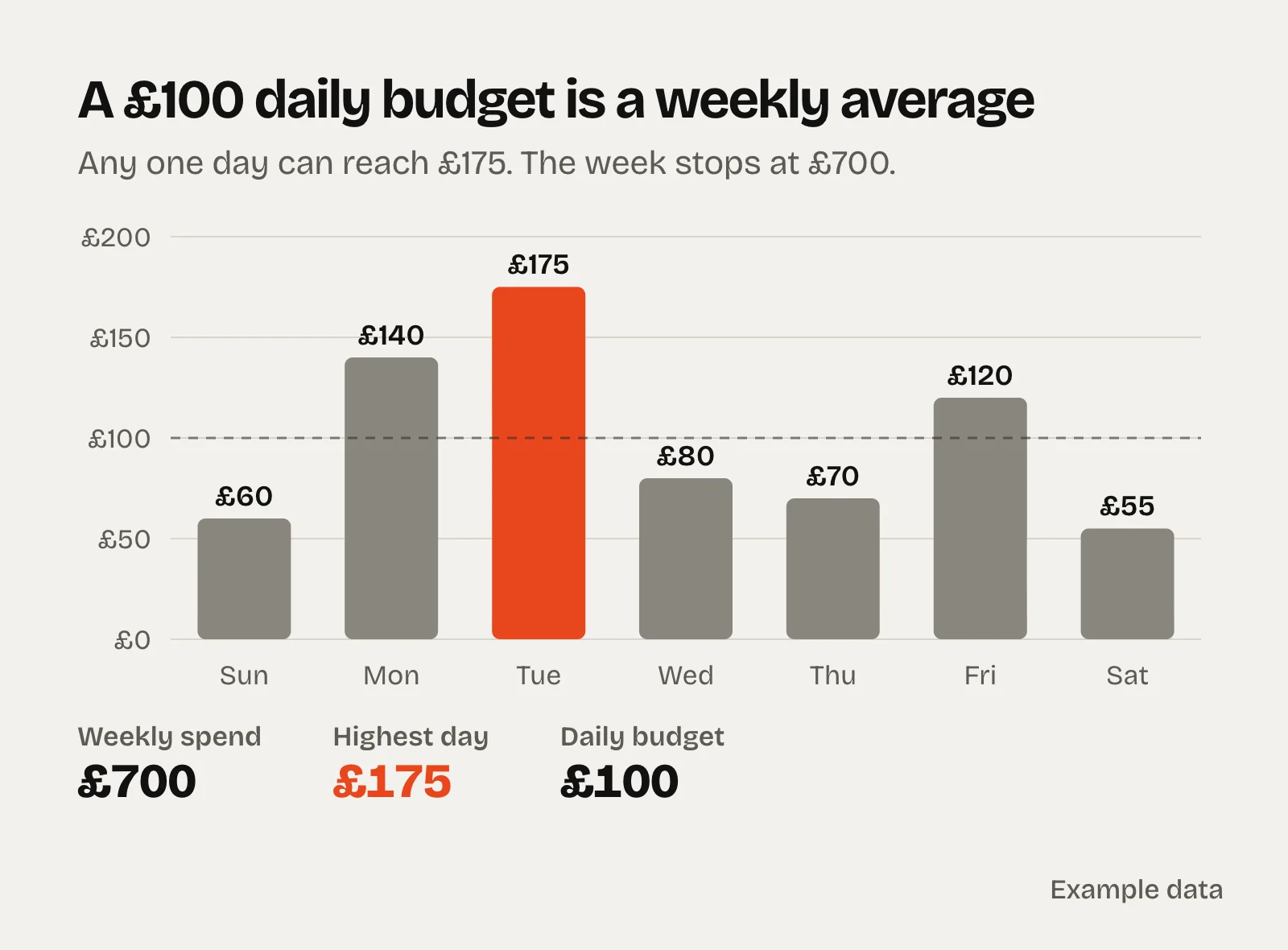
Daily spend moves around under all three. On days with better opportunities, Meta may now go up to 75% over a daily budget, up from 25% before late 2025. The limit is weekly: no more than seven times the daily budget, Sunday to Saturday. A day at £175 on a £100 budget is normal, so judge pacing by the week. With sharing on, one ad set can reach £210 in a day and £840 in a week, while the campaign’s total stays the same.
Meta’s own figure for campaign budgets is a 4.6% lower CPA on average. That’s worth having, and small enough that the choice of budget setting won’t rescue a weak account. How many ad sets you run usually matters more.
Work out how many ad sets you can afford
Ad sets usually leave the learning phase after about 50 results in the week after their last significant edit, and Meta says performance is less stable and usually costs more until then. In a post last month it gave a simple formula for this: weekly budget divided by (cost per result × 50) is the most ad sets your budget can support. It also said ad sets below that level ran about 28% more expensive per purchase. It didn’t say how it measured that, so we read it as a direction rather than a benchmark.
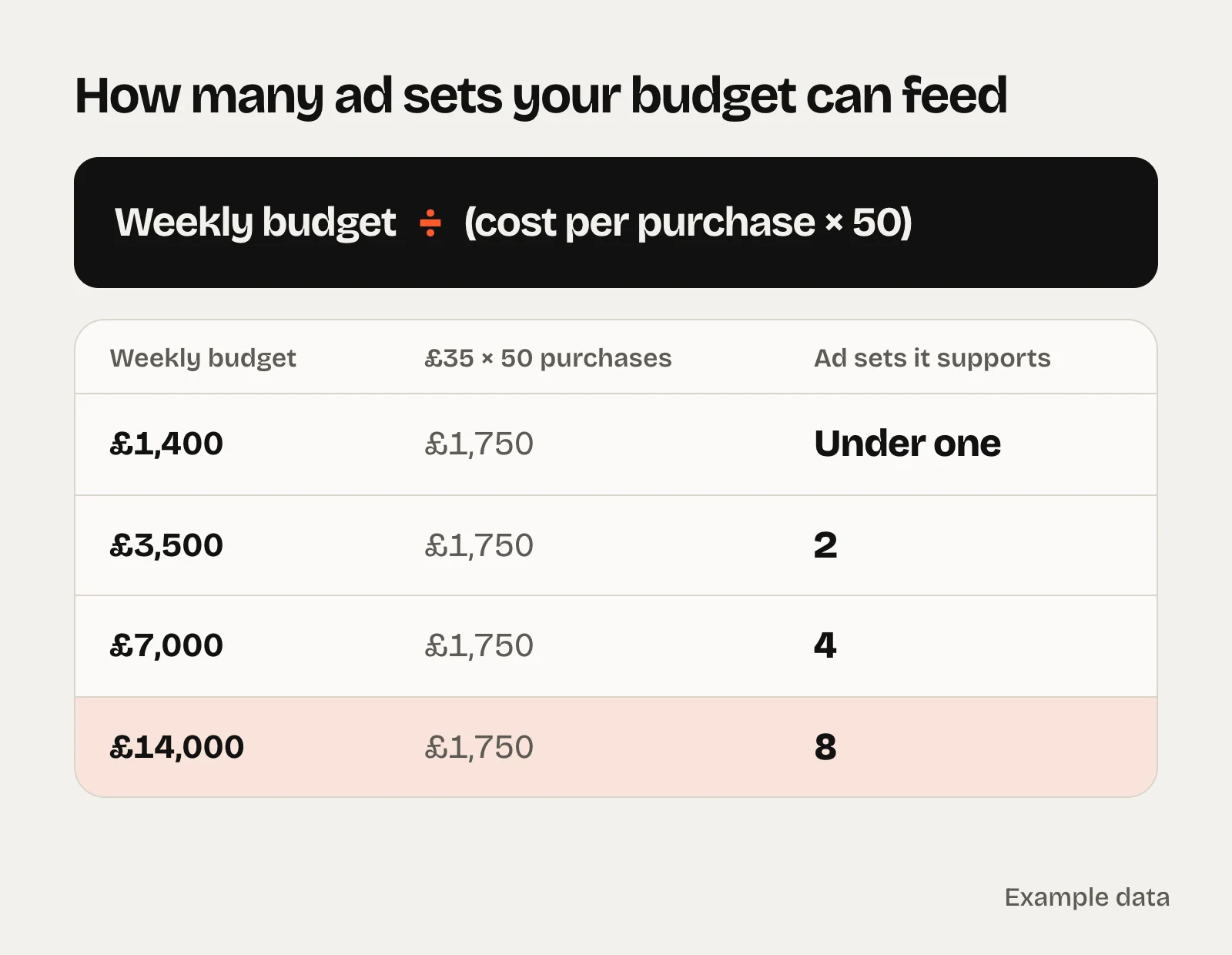
Run this first, because it often settles the question. If your budget supports two ad sets and you’re running nine, moving the budget up a level won’t fix it. Combine similar ad sets. If you split them to see results by age, region or placement, use breakdowns in reporting instead, which is what Meta recommends too.
When we use a campaign budget
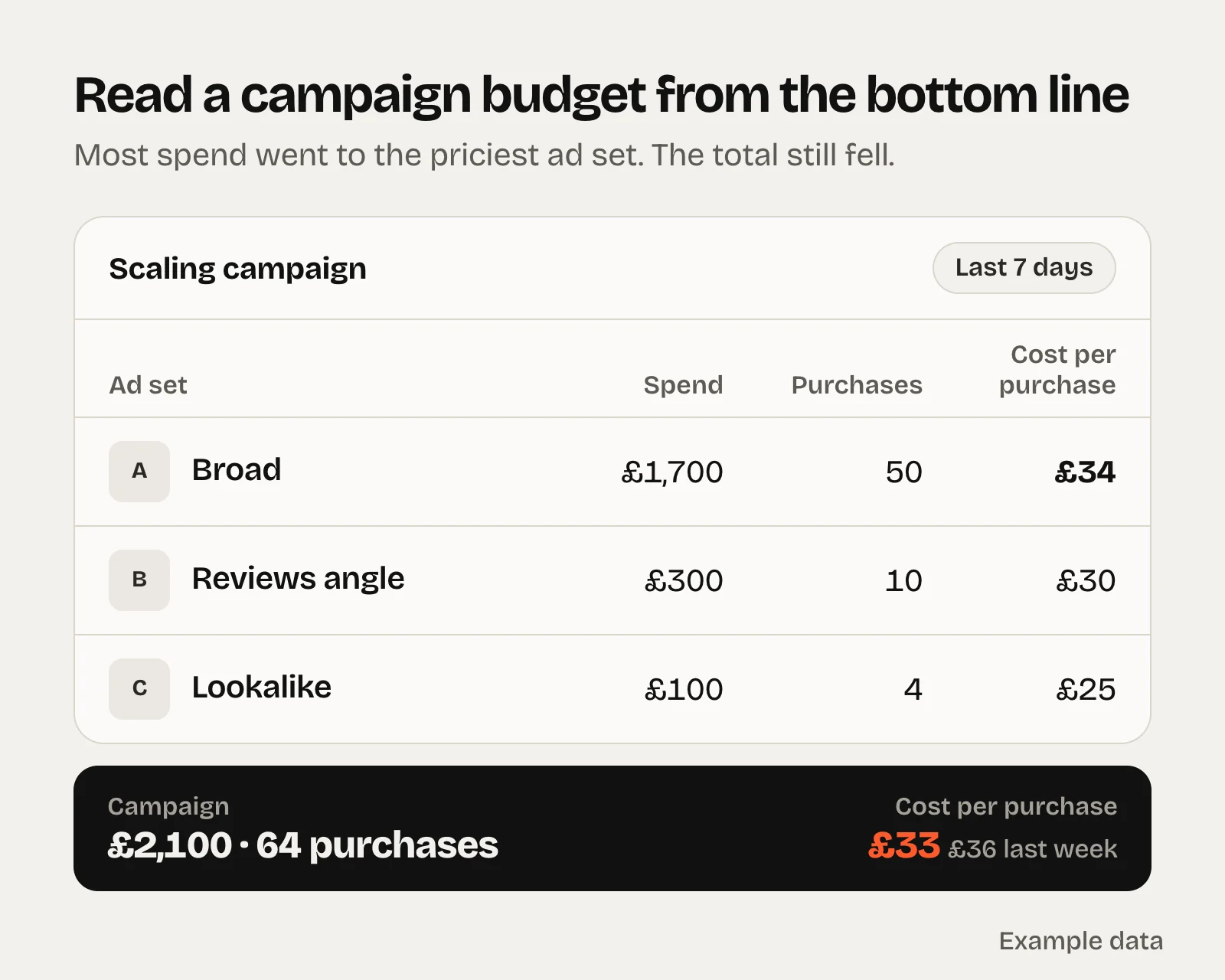
We reach for it when ad sets share the same goal, are worth about the same to the business, and hold ads that have already proved themselves. That’s scaling: we want the most purchases at the lowest cost, and we don’t mind where they come from.
The discipline is in how you read it. An ad set can look expensive and still be getting most of the spend, because it’s reaching further than the others. Meta’s advice is to judge the campaign’s total results and its average cost, and we agree. If you doubt the split, test it with an A/B test.
When we use ad set budgets
Four situations, three of which come straight from Meta’s own guidance:
- Tests. A new concept needs a fair amount of spend to be judged. Under a campaign budget, the current favourite can take the money before a new idea has had a proper run.
- Ad sets that differ in value. A subscription offer and a one-off bundle might have very different margins. Unless your bids can express that difference, Meta will treat a purchase as a purchase.
- Very different audience sizes. A small retargeting pool next to a broad audience will usually lose out under a campaign budget.
- Mixed goals or bid strategies. A campaign budget needs the same bid strategy across ad sets, and with highest volume, the same optimisation event.
Sharing is useful when you want those fixed budgets but would rather not chase small imbalances by hand. Decide at setup: Meta’s developer guide says it can’t be switched on once a campaign is live.
How we test new concepts
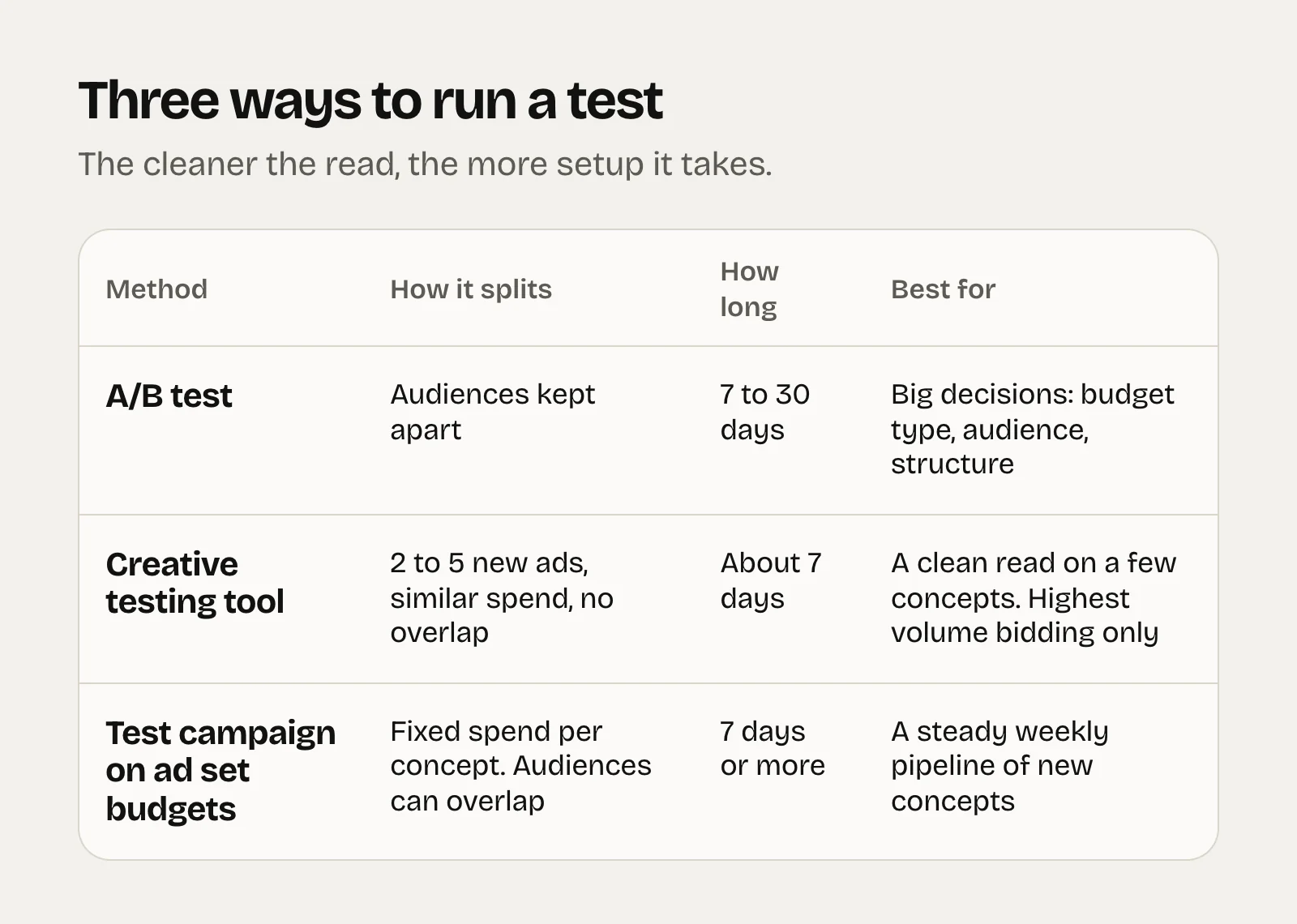
Ad set budgets fix spend per ad set, and inside an ad set Meta still favours some ads over others. So we put one concept in each test ad set, with a few versions at most. That compares ideas fairly, and it also keeps ad volume down, which Meta’s guidance asks for: too many ads and fewer of them leave learning.
There are three ways to run the comparison, and they suit different questions.
Set the test budget by the purchases you want to see. We look for around 20 purchases per concept before judging it. At a £35 cost per purchase, that’s £700 a concept, or £100 a day over a week. Meta recommends at least seven days for a test, and longer if your customers usually take more than a week to buy.
The structure we start from
Two campaigns, same goal, same offer. One finds new winners, and the other spends behind them.
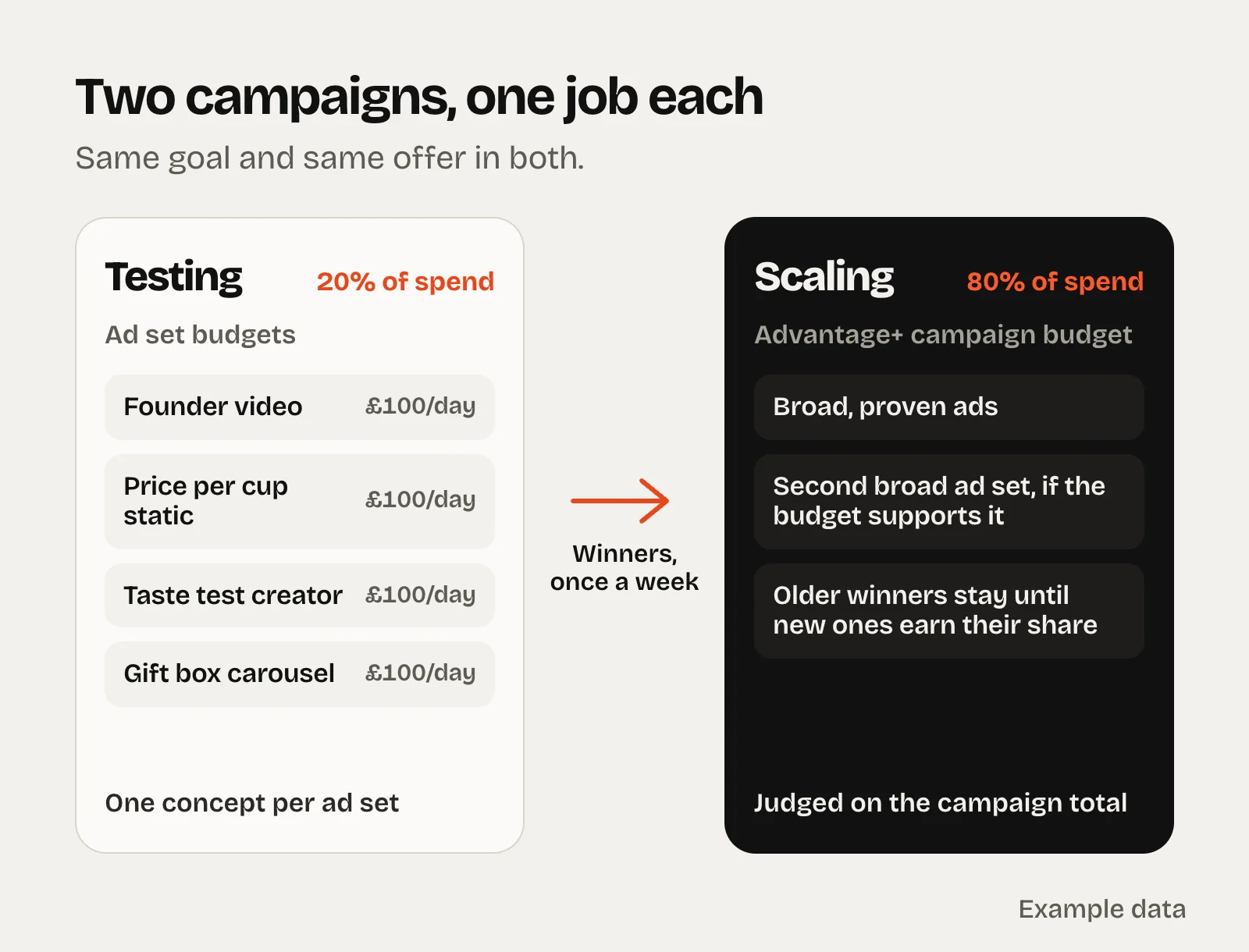
The 80/20 split is where we start, and it changes with the account. A brand with a tired set of ads leans further towards testing. Meta’s creative testing tool suggests setting aside no more than about 20% of a budget, which lands in the same place.
Keep the scaling campaign small. Adding an ad counts as a significant edit, so we move winners once a week in one batch, using the existing post so likes and comments come with it.
When a test graduates
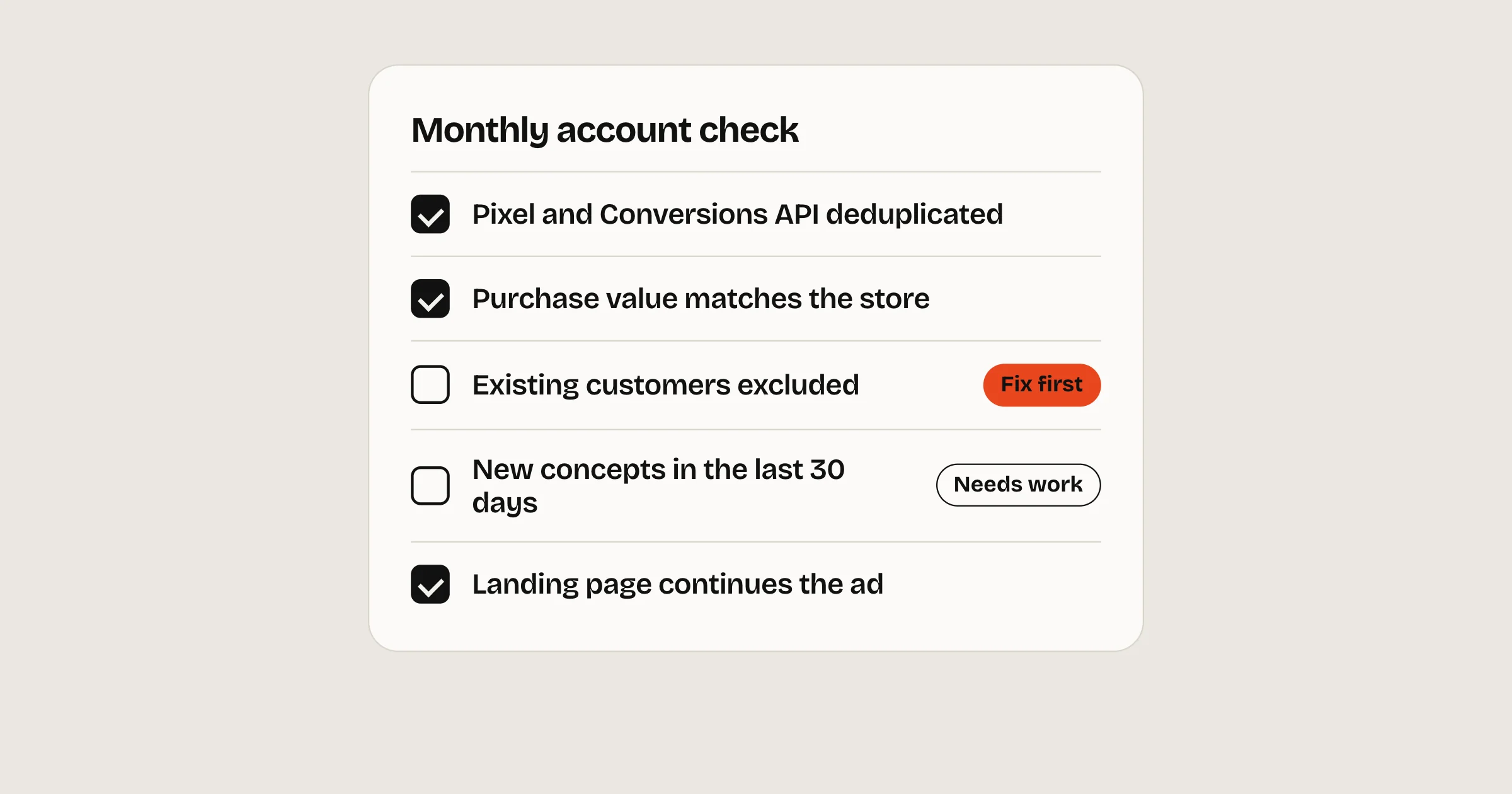
A concept moves across when it has run at least seven days, has around 20 purchases, sits at or below the target cost per purchase, and holds its order value in the store’s own data. The rest stays in testing or gets cut. A close call gets another week.
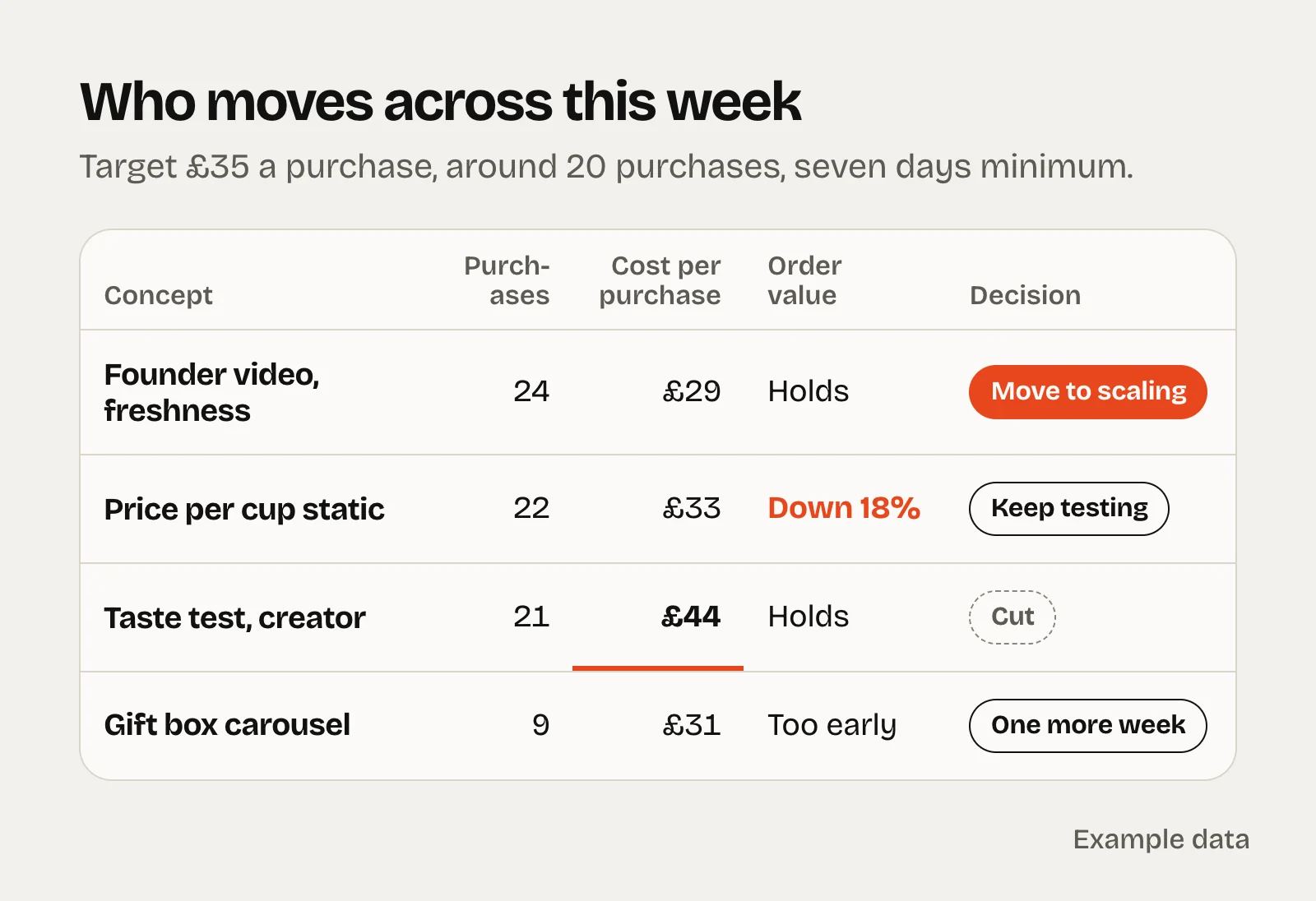
Some winners fade at higher spend, so we leave the older ads running until the new one has earned its share. We read that at campaign level, over a full week.
Scaling without resetting learning
Meta doesn’t publish a safe percentage for budget changes. Its help page says going from $100 to $101 is unlikely to reset learning and $100 to $1,000 may do. The “20% rule” you’ll see quoted is an industry habit. We still move in steps of about that size, a few days apart, because it keeps each change small enough to read.
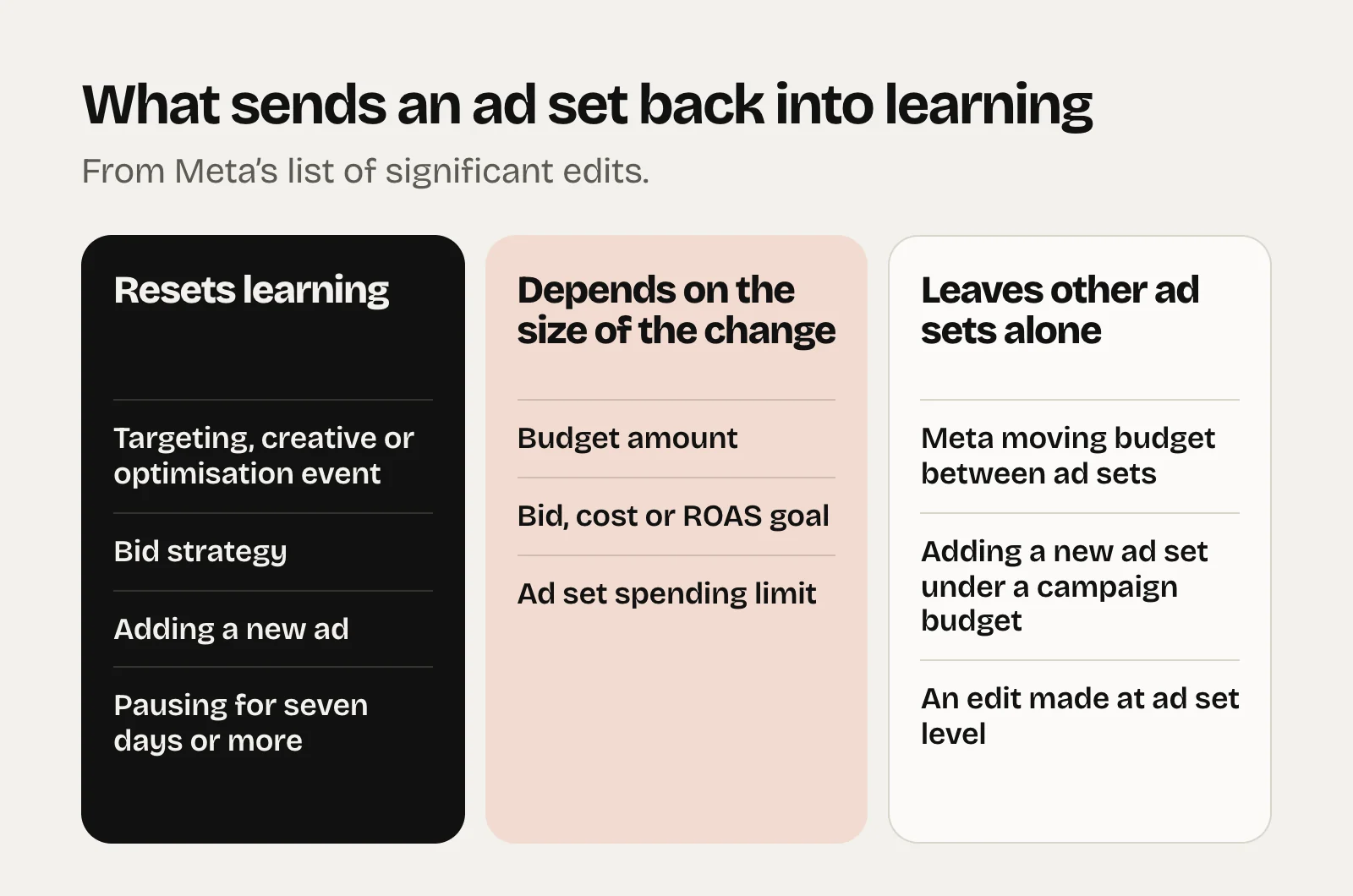
The budget type changes how far an edit reaches. A new campaign budget can send several ad sets back into learning at once, while an edit made at ad set level stays with that ad set. So we group changes into one sitting. Meta’s post last month made the same point: one learning phase instead of five.
Where Advantage+ fits
A sales campaign only counts as Advantage+ when the budget sits at campaign level, with Advantage+ audience and placements in place. So a scaling campaign can be Advantage+, and a testing campaign on ad set budgets won’t be. That’s fine: they’re doing different jobs, and the label doesn’t change how we judge either one.
Which one to use
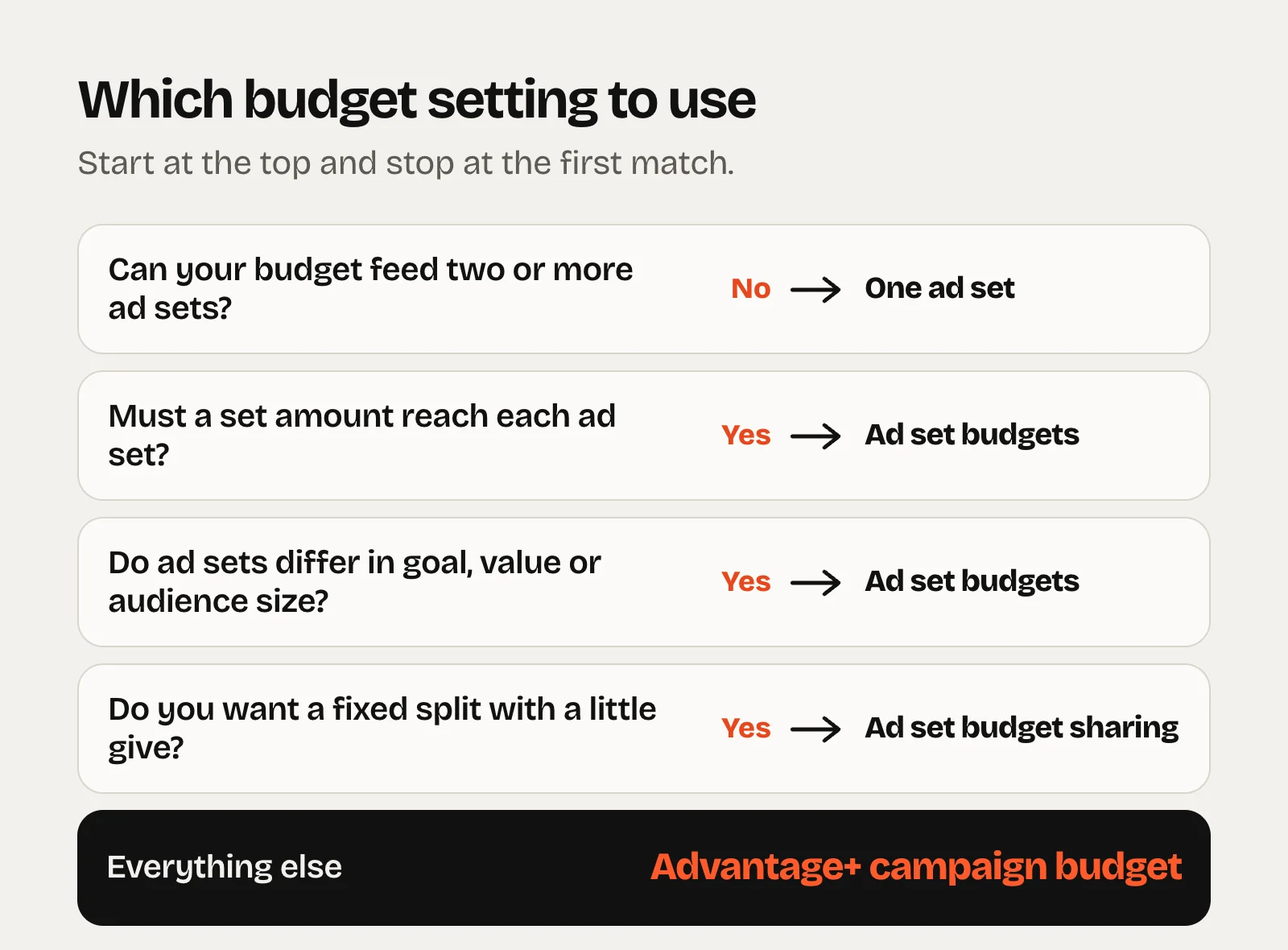
Four habits undo most of this, whichever you choose:
- Rebuilding ABO with spend limits. Meta says to use them sparingly, or not at all. If every ad set needs its own limit, use ad set budgets.
- Pausing low-delivery ad sets in a campaign budget. Paused ad sets drop out of consideration, and Meta warns this can raise cost per result on the ones still running.
- Judging a campaign budget one ad set at a time. It’s built to be read as a whole.
- Switching back and forth. There’s a two-hour lock on the toggle, and you lose any clean before and after. If you want to know which suits an account, run an A/B test.
If you want one thing to try this week, run the formula on your largest campaign. If it’s running more ad sets than the answer, combine the most similar ones in one sitting, then leave it alone for a full week before you read it.