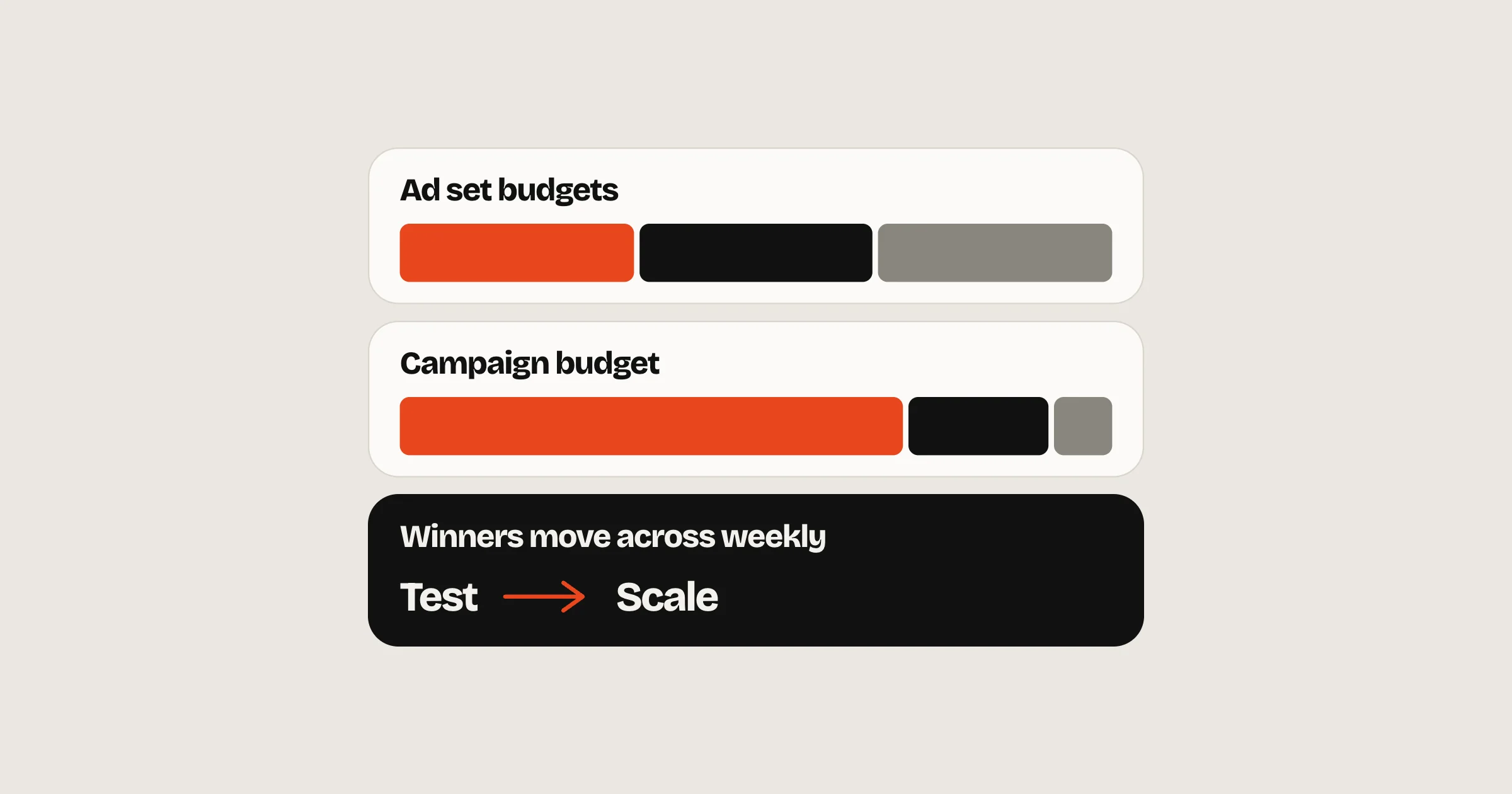
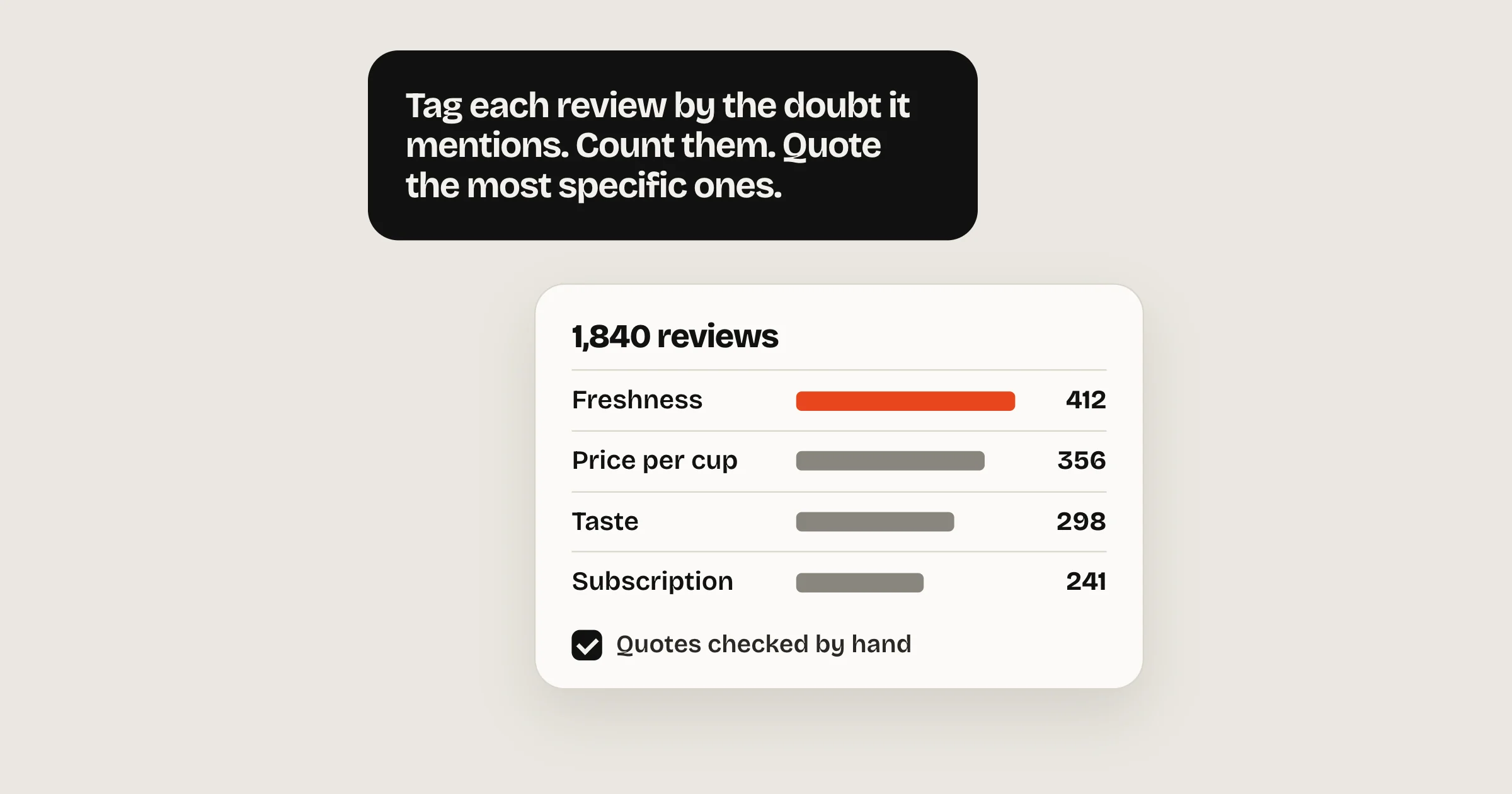
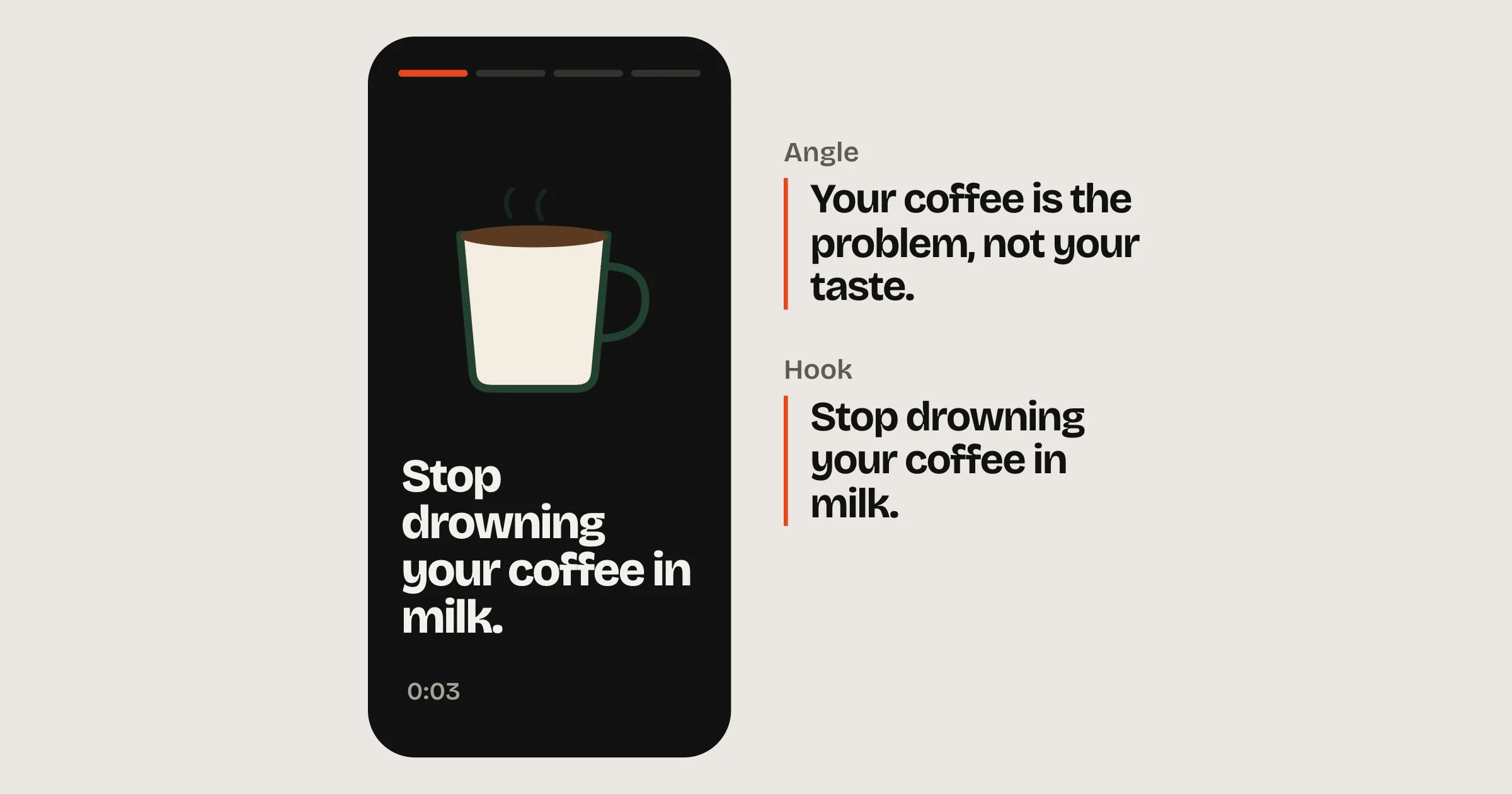
How many ads per ad set? Creative volume Meta can actually learn from
There’s no magic number. An ad set can hold 50 ads, but it only learns from as many as its budget can feed, and only when they’re different enough for Meta to tell apart.
On this page
Last week we worked out how many ad sets a budget can feed. The next question is what goes inside them. “How many ads should be in an ad set?” is one we get asked a lot, and the answers online run from three to fifty.
Meta used to give a number: six or fewer. That line has gone from its help pages, and Meta now asks for more creative variety, not less. Both bits of advice still hold once you separate the number of ads from the number of ideas. Here’s what Meta says now, how we work out how many ads an ad set can learn from, and the setup we start from.
The short version
- Meta allows 50 ads per ad set. Its own advice is to run fewer, with more variety in each.
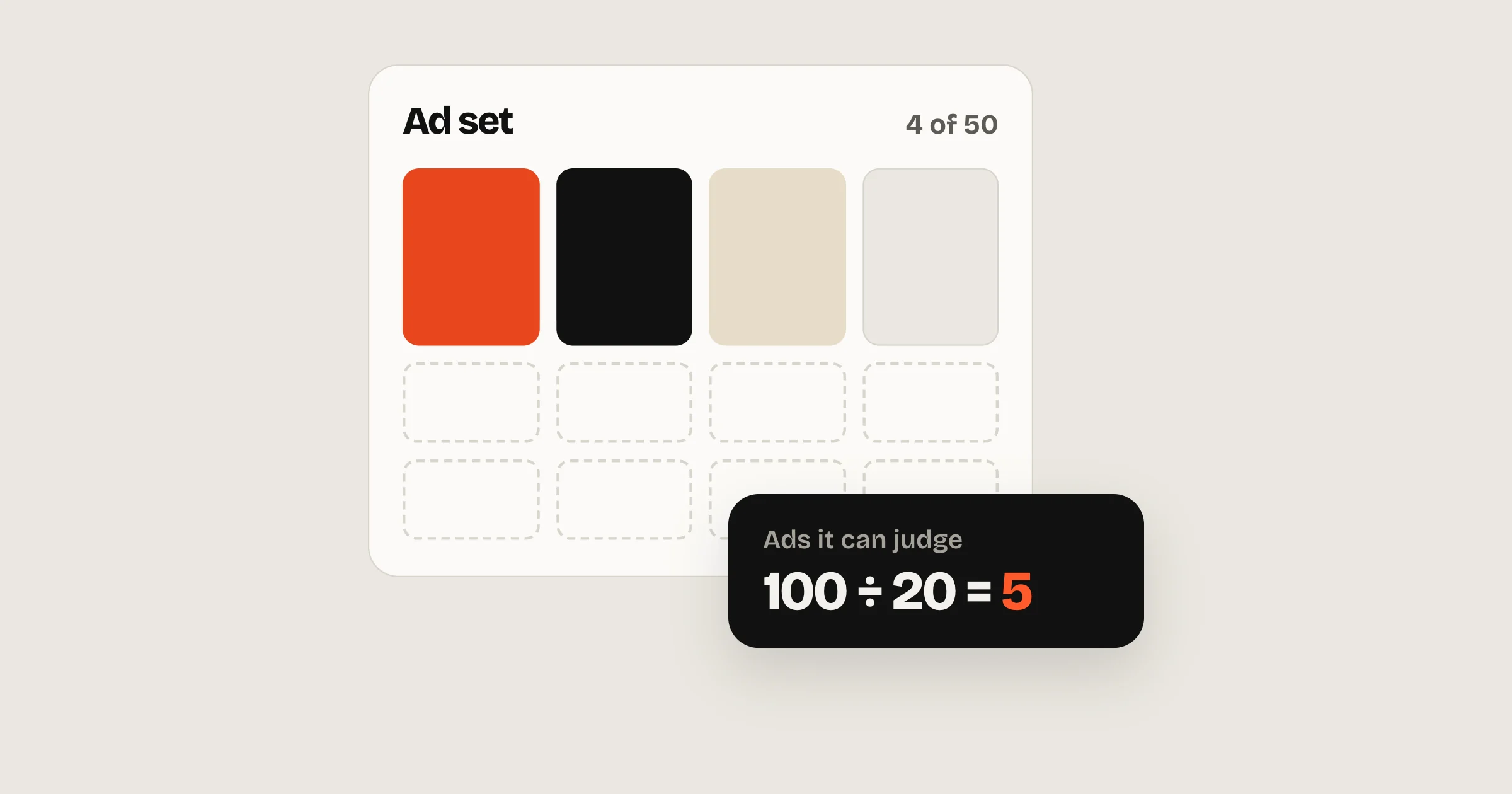
- An ad set can only learn from the ads its budget can feed. Weekly purchases ÷ 20 is roughly how many ads a test ad set can give you a read on.
- Count concepts, not ads. Five versions of one idea can look like one ad to Meta.
- Put small variations inside one ad, and add new ads in one weekly batch.
What Meta says now
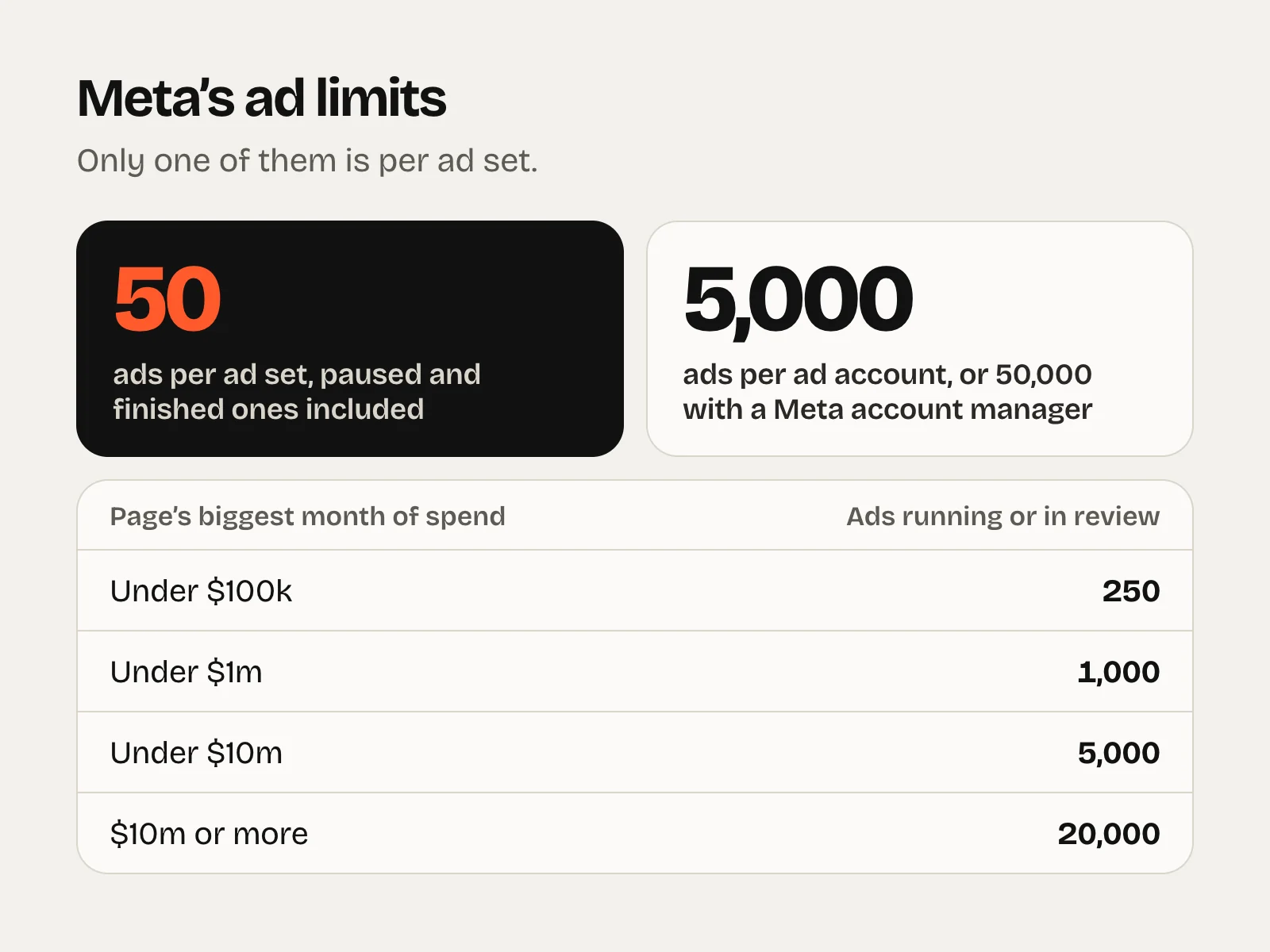
There are three limits, and only one of them is per ad set:
- 50 ads per ad set. Paused and finished ads count too, not just live ones.
- 5,000 ads per ad account, or 50,000 if you have a Meta account manager.
- A limit per Page on ads running or in review. It starts at 250 and rises to 1,000, 5,000 and 20,000 as the Page’s biggest month of spend passes $100k, $1m and $10m.
The advice sits on Meta’s page about managing ad volume, and it’s blunt. When you run too many ads at once, each one delivers less often, fewer leave the learning phase, and “too many ads can result in worse performance”. Its fix is to cut the number of ads per ad set but keep diverse creative in each one, using ads that hold several images, videos and lines of text.
Meta’s creative advice pulls the other way. Its 2024 holiday guidance said to launch new ads every week and keep at least 20 diversified ads in an Advantage+ shopping campaign. The two don’t conflict. One is about how many ads you ask a budget to learn from. The other is about how many different reasons to buy you give it.
Why more ads can mean less learning
Learning happens at ad set level. Meta says an ad set usually leaves the learning phase after about 50 results in the week after its last significant edit, so each ad doesn’t need 50 of its own. But you still need enough purchases on each ad to tell whether it works, and every ad in the set draws on the same budget.
Take an ad set that gets 100 purchases a week. Shared evenly across four ads, that’s 25 each, which is enough to judge. Across twenty, it’s five each, and none of them can be judged.
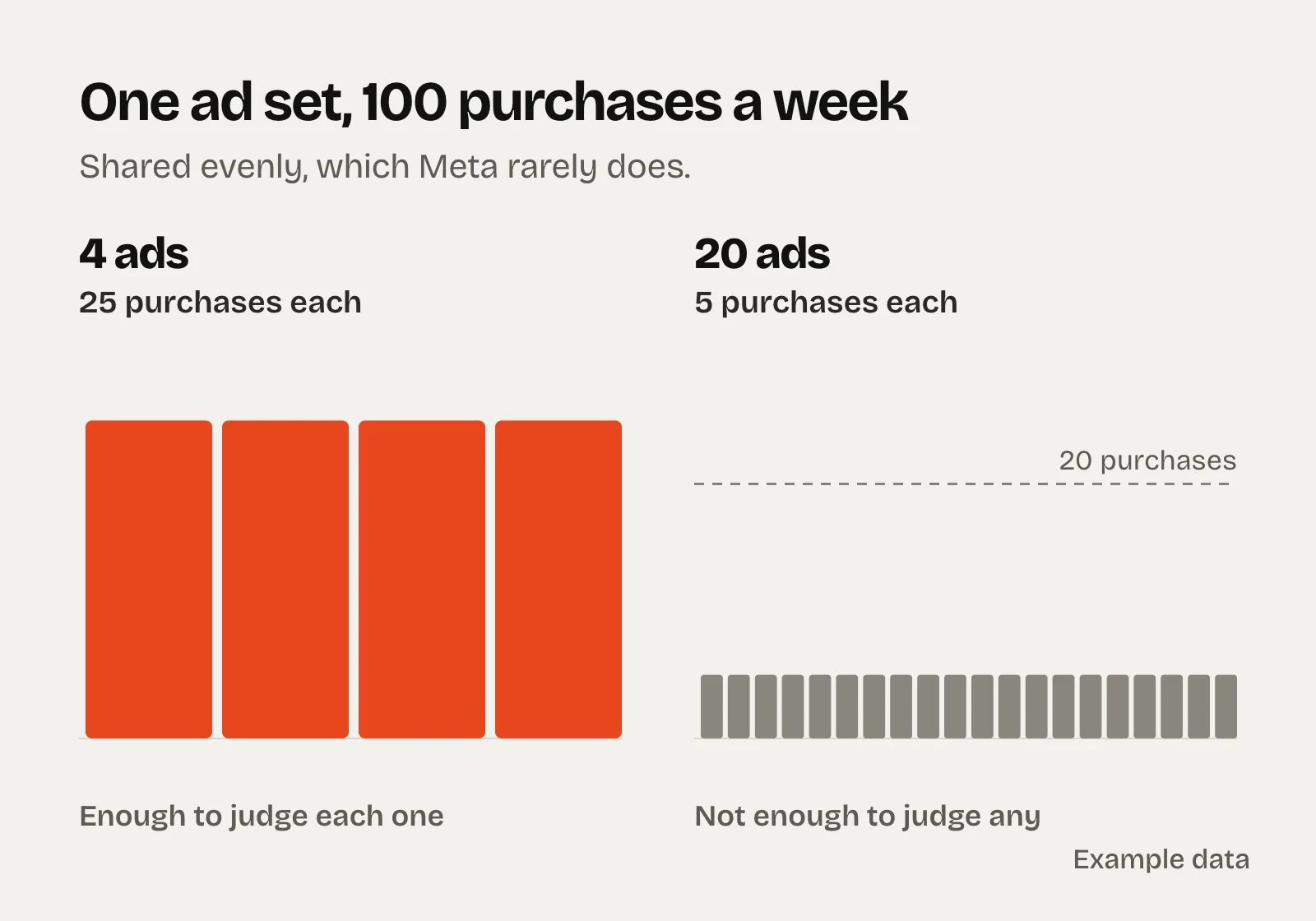
It’s never shared evenly. Inside an ad set, Meta puts most of the money behind the ads it expects to do best, and the rest get a little delivery, then almost none. In an ad set with a dozen ads, it’s normal to find two taking most of the spend and half sharing a sliver.
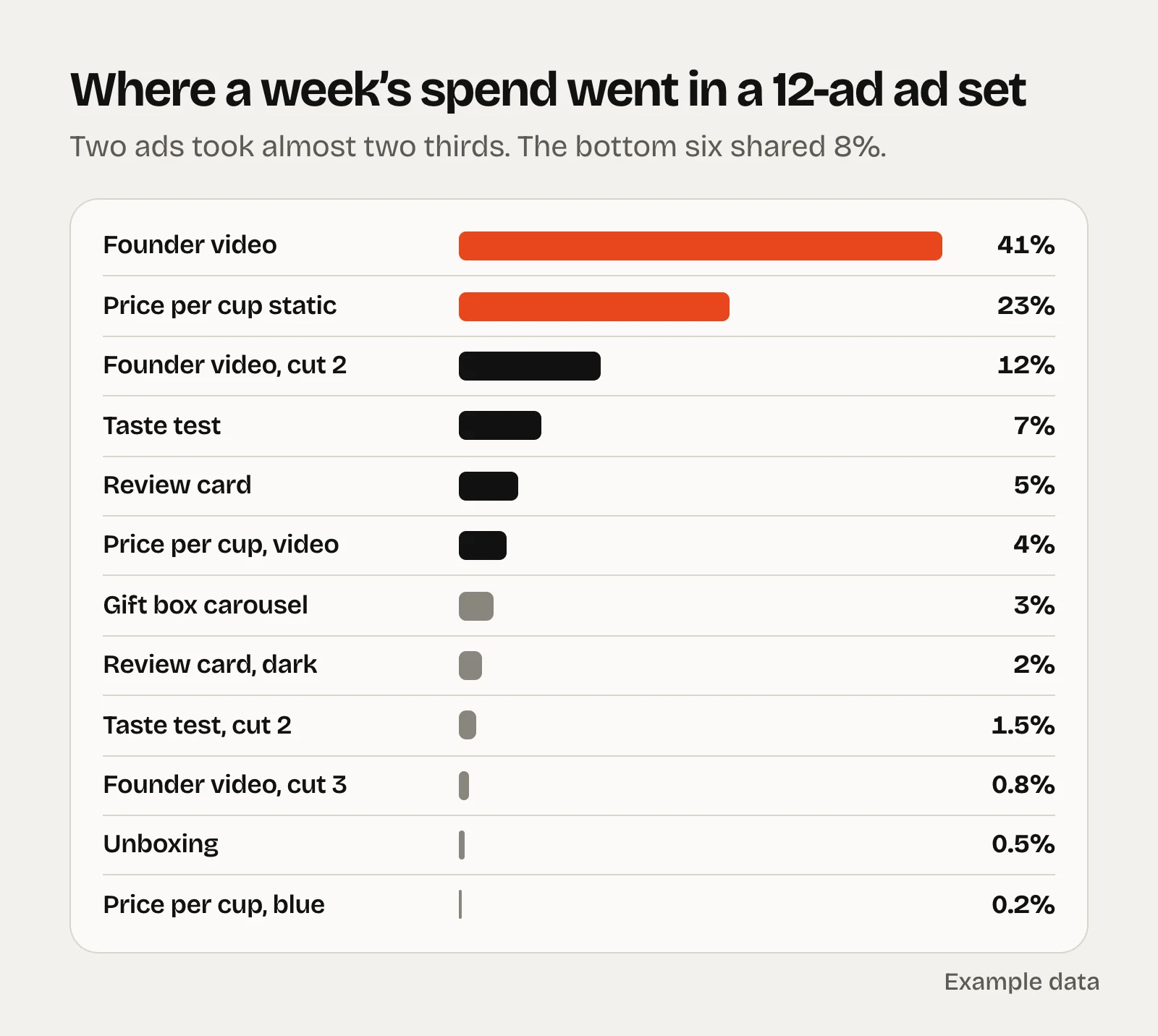
That isn’t always bad. If the two leaders are your best ads, Meta has done its job. The cost is underneath: those ads never get a fair hearing, so a good idea can sit in an ad set for a month without you finding out. In one account we run, after a month of heavy launching, only about one in nine new ads got meaningful spend, and about one in six of those beat the account’s average. Between them, the new ads took about two fifths of the budget and returned about a third less than the ads already running.
Work out how many ads your budget can read
For ad sets, Meta’s sum is weekly budget ÷ (cost per result × 50). We use a second sum for the ads inside a test ad set:
Ads you can judge in a week = weekly purchases in the ad set ÷ 20
Twenty purchases is where we’re willing to call an ad. It’s our threshold, not Meta’s, and it matches the one we use for test concepts. At a £35 cost per purchase it works out like this:
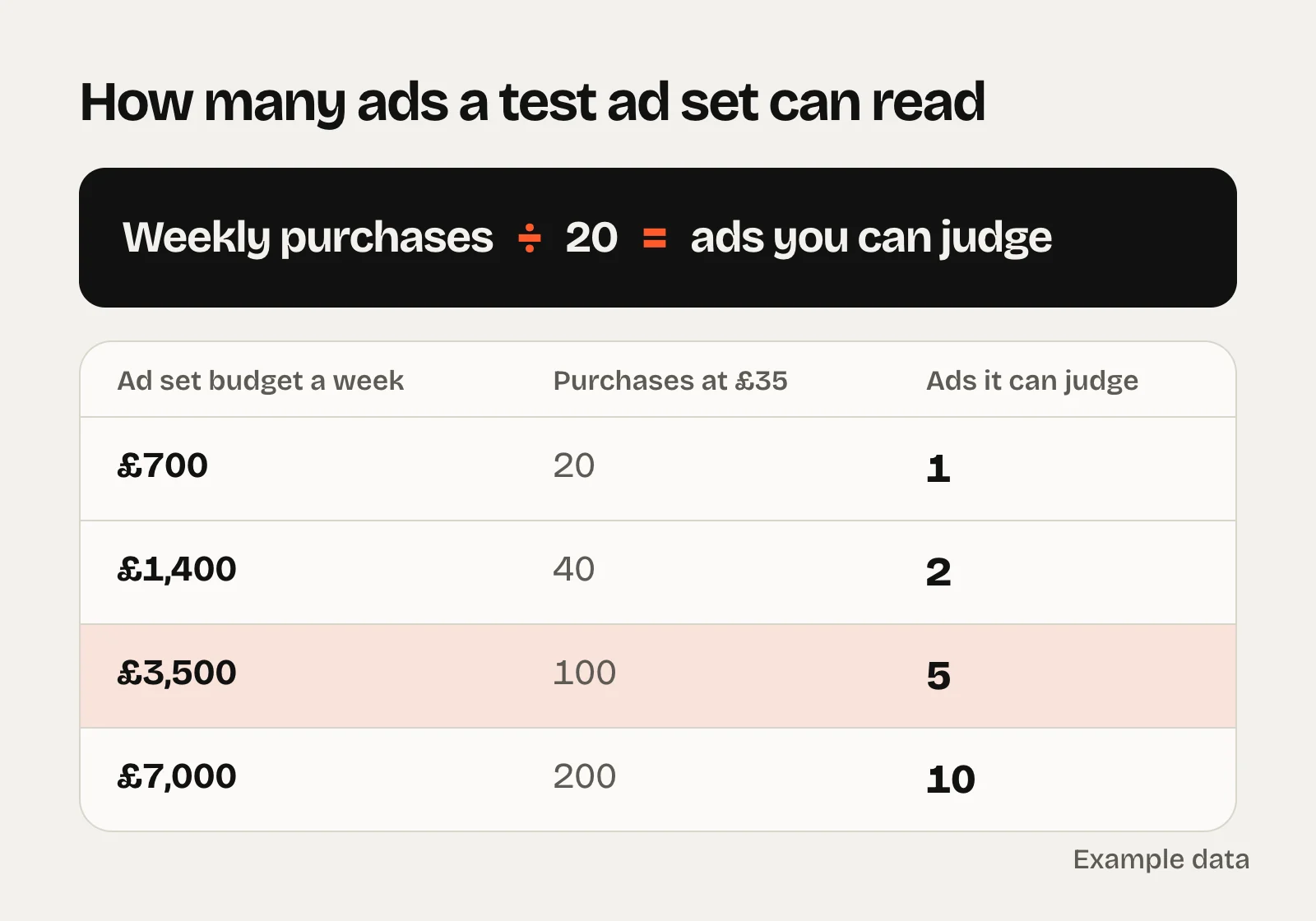
Treat the answer as a ceiling. Spend won’t split evenly, so an ad set that could read five ads on paper might give you a clean read on three. If the sum says one, test one concept per ad set and keep its versions inside a single ad.
Count concepts, not ads
Five versions of the same static with slightly different headlines are five ads in Ads Manager. To Meta they may be closer to one. Its guidance on creative differentiation says that when ads are too similar, the system may not recognise them as different and could show them to the same people. That limits reach, and it’s how ad sets end up flagged as Creative limited or Creative fatigue.
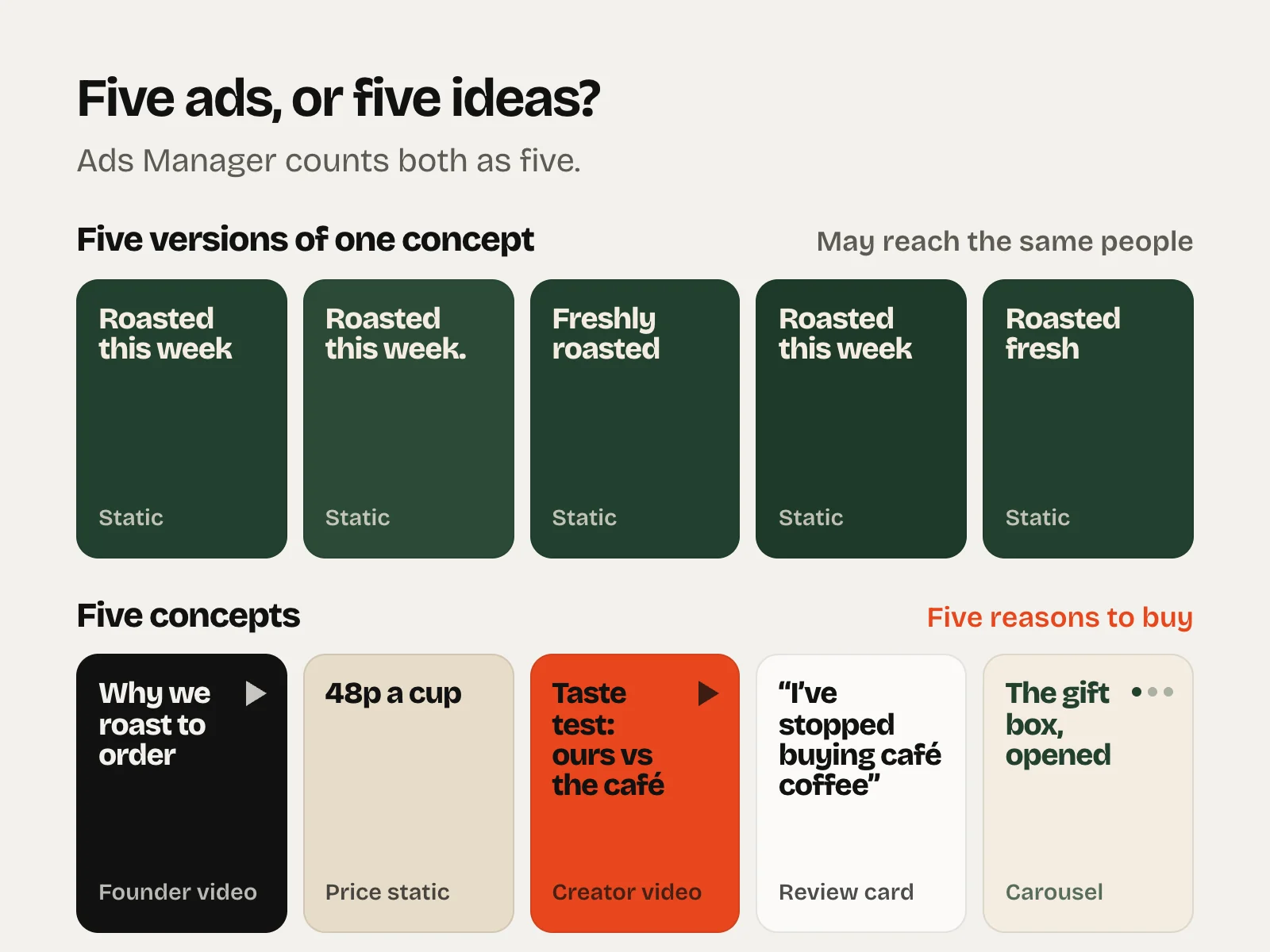
A concept is a different reason to buy: a different angle, a different person talking, a different format. Meta’s own examples are price, performance, ease of use and a recommendation from a creator the viewer trusts. New colourways and reworded headlines are versions. They’re worth testing, but they belong inside one ad.
Put the versions inside one ad
This is the part of Meta’s advice most accounts skip. With the flexible format, one ad can hold up to ten images and videos. With multiple text options, it can hold up to five versions each of the primary text, headline and description. Meta then picks the combination for each person, and its ad volume page says one ad with several text options is usually more effective than several ads without them.
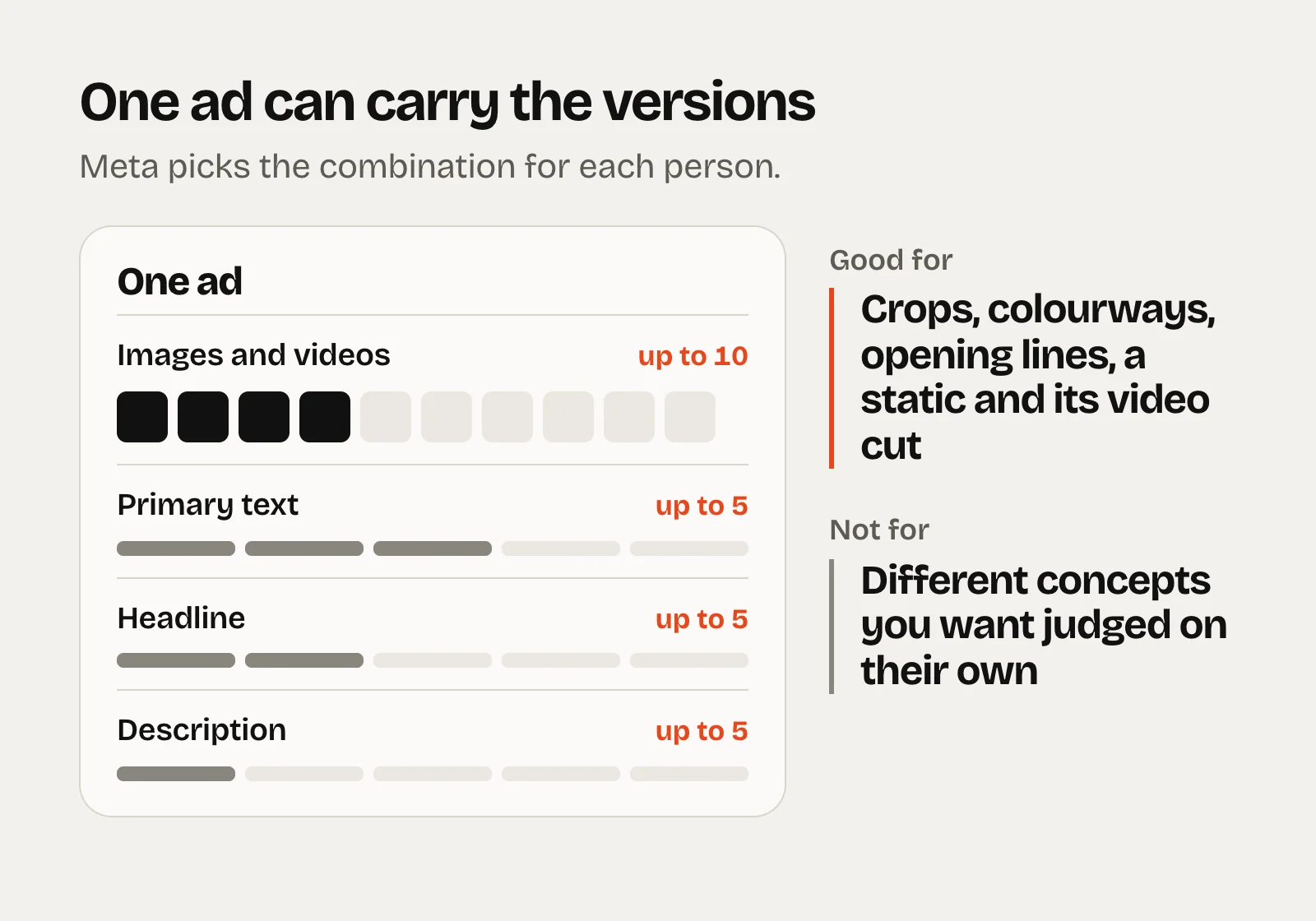
We use this for versions: the same concept in three crops, four opening lines, or a static and its video cut. The concept gets one ad and one share of the budget, rather than five ads fighting over it. The trade-off is reading it. Ads Manager can break results down by asset, but Meta chose who saw what, so it isn’t a fair test. Anything you want judged on its own still gets its own ad.
For sales and app campaigns, Meta has been moving advertisers from dynamic creative to the flexible format since June 2024, so that’s the one to learn.
Add new ads in batches
Adding a new ad to an ad set is a significant edit. It sends the ad set back into the learning phase, where Meta says delivery is less stable and cost per result is usually higher. Add one new ad a day and the ad set can spend the whole week relearning.
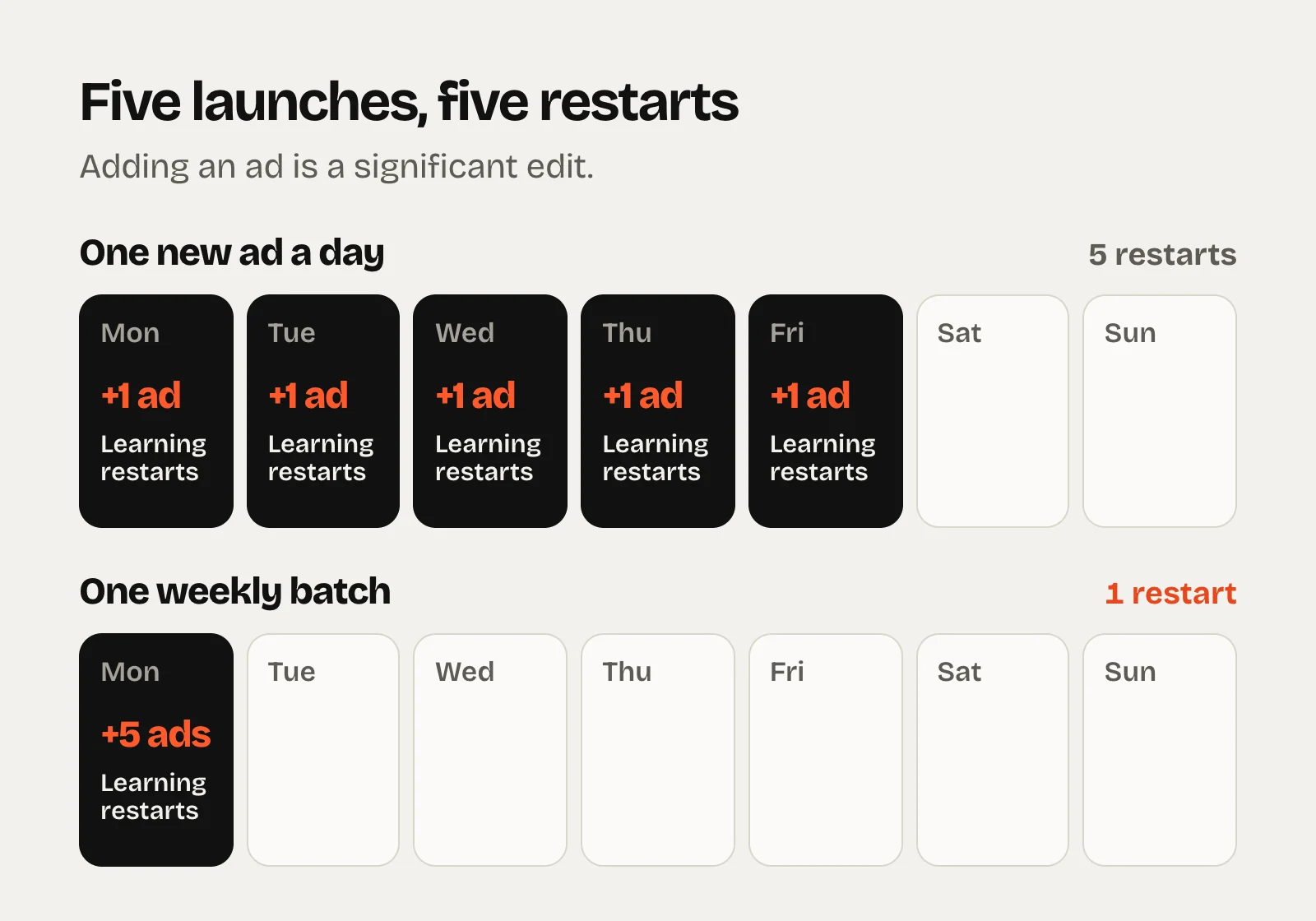
So we add new ads once a week, in one go. Meta’s own peak-season advice says the same about every change: group them, and take one learning phase instead of five. If new creative lands on a Wednesday, it waits for the next batch.
When to take ads out
Meta flags tired ads in the Delivery column. It compares the ad’s cost per result with ads you’ve run before, and it counts every recent showing of the same image or video from your Page, across all your campaigns.
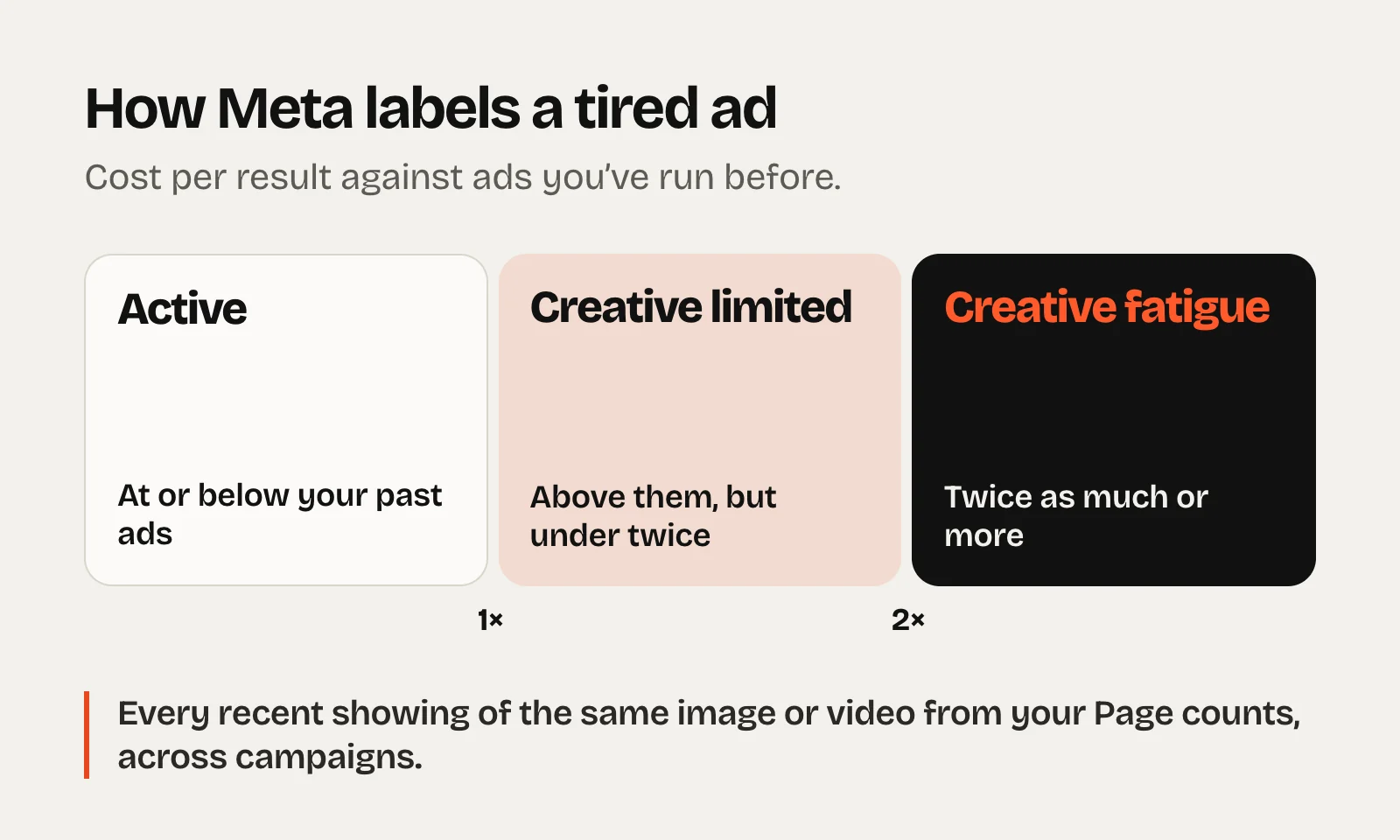
Two details are easy to miss. Creative limited shows up as soon as cost per result passes your past ads, well before fatigue. And Meta’s fix is to add an ad that’s materially different, not to switch the old one off. It even notes that keeping the original running may get you more results.
So we don’t pause a winner on a warning. We add a new concept, let it earn its share, and turn the old ad off once the ad set’s total holds without it. The ads we do cut are the ones at the bottom: an ad that has barely spent in two weeks isn’t being tested, it’s just crowding the ad set. Jon Loomer, who has written about Meta ads for years, makes the same case for pruning ads Meta rarely shows, and for starting with a few creatively different ads rather than many.
The setup we start from
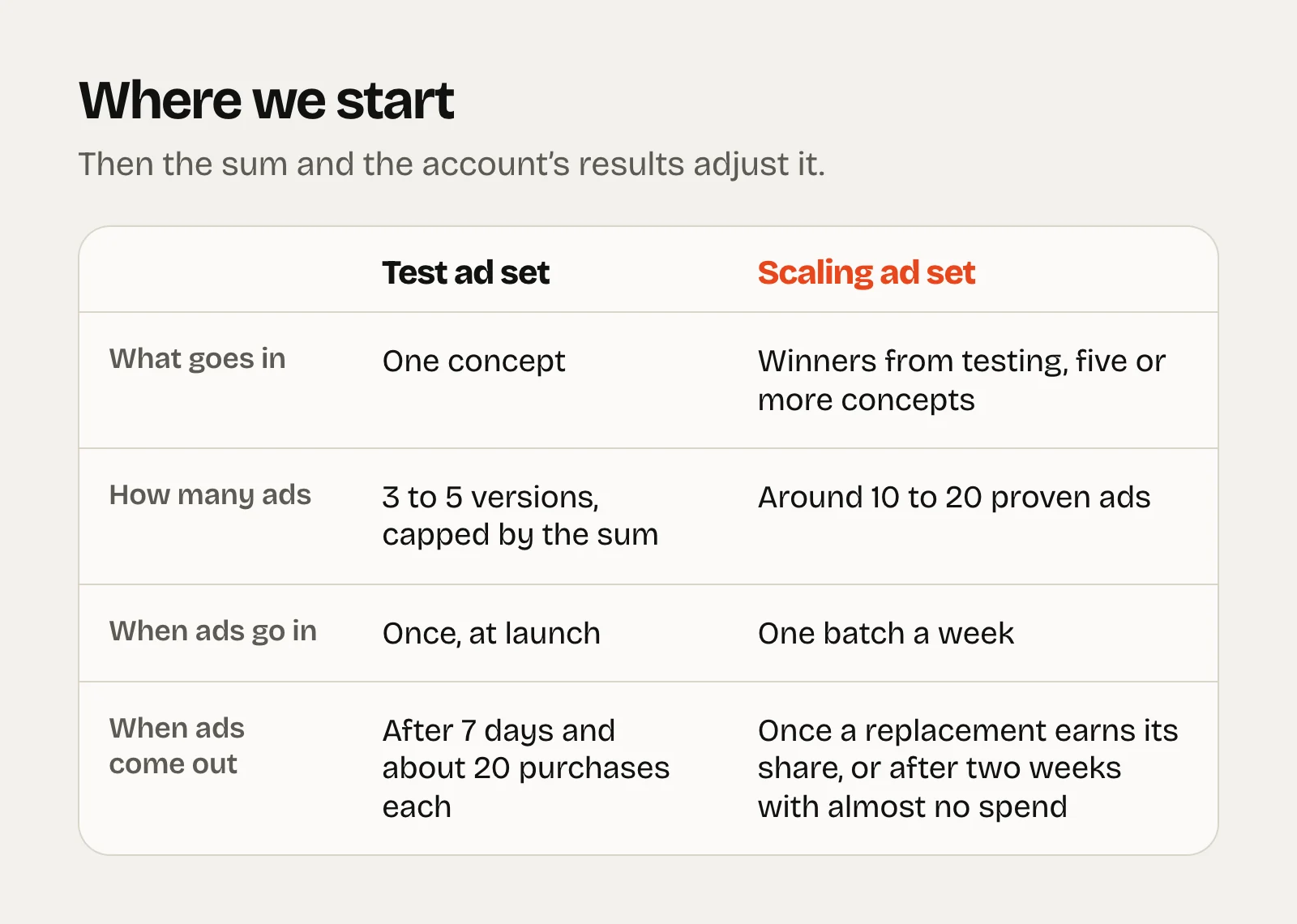
Test ad sets hold one concept each, with three to five versions, as many as the sum allows. Scaling ad sets hold proven ads only, from at least five different concepts. Across one or two scaling ad sets, that lands close to Meta’s figure of 20 or so diverse ads, without asking one ad set to learn from 50.
If an ad set already holds too many ads, fix it in this order:
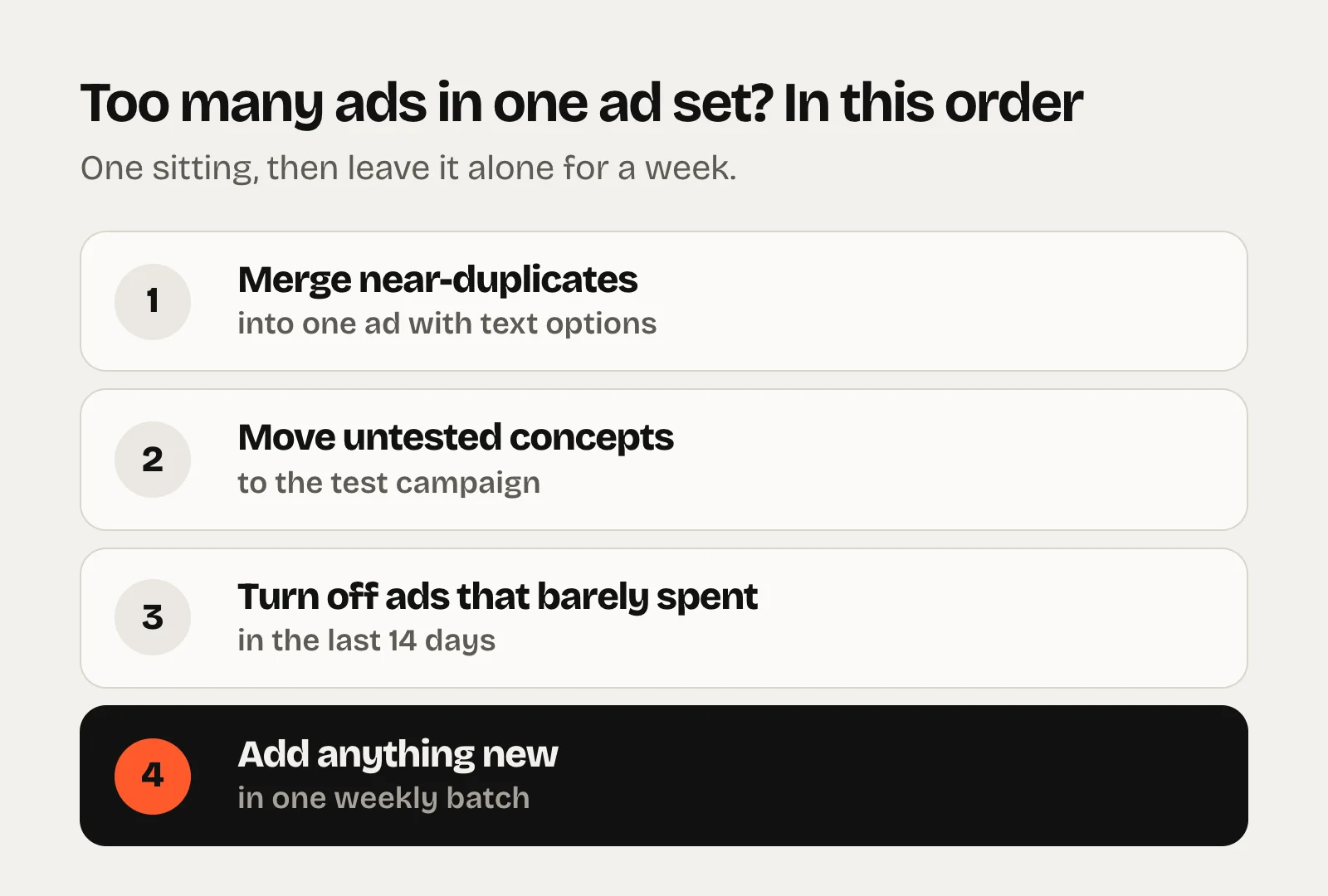
Do it all in one sitting, since each step is an edit, then leave the ad set alone for a week before you read it.
If you want one thing to try this week, open your biggest ad set, sort its ads by spend over the last 14 days, and count how many had a real share. If it’s fewer than half, the ad set holds more ads than it can learn from. Move the rest out in one sitting.
Questions we get asked
What is the maximum number of ads per ad set on Meta?
Fifty, and paused and finished ads count towards it. An ad account can hold 5,000 ads, and each Page has its own limit on ads running or in review, starting at 250.
Does adding a new ad reset the learning phase?
Yes. Meta lists adding a new ad to an ad set as a significant edit, so that ad set goes back into learning. Adding a new ad set under a campaign budget doesn’t reset the other ad sets.
Is six ads per ad set still the rule?
No. Meta’s page on managing ad volume no longer gives a number. It says too many ads can hurt performance, and asks for fewer ads per ad set with more variety in each.
How many new ads should we launch each week?
As many concepts as your test budget can judge, which the sum above tells you. Meta’s guidance is to launch new ads every week. We’d rather launch three concepts with a fair budget each than fifteen that share it.