How we use AI in creative strategy, and where we keep it out
AI does the slow parts of our creative process well. It doesn’t choose what an ad should say or know what’s true about your product, so those stay with people.
On this page
- 1. Reading reviews, comments and tickets at scale
- 2. Drafting variations of a line that already works
- 3. Resizing for every placement
- 4. First drafts of briefs and scripts
- 5. Choosing the angle stays with us
- 6. Product shots stay real
- 7. Real people, not synthetic customers
- 8. Meta’s built-in AI: what we switch on
- A week of creative, with AI in it
- How to tell if AI is helping
Reading two thousand product reviews properly takes most of a day. An AI model gets through them in a few minutes, and the time goes into checking what it found instead. That’s the kind of job AI does well in creative strategy: slow, repetitive work where a person can check the answer quickly.
Meta wants it to do much more. By late 2024 it said more than a million advertisers had used its generative AI tools to make over 15 million ads in a single month, and in 2025 the Wall Street Journal reported that Meta wants brands to hand over a product image and a budget and let AI make the rest by the end of 2026. Several of those tools are already in Ads Manager, and some switch on by default.
We use AI every week. We also keep it away from a handful of decisions, because those are the ones that decide whether an ad sells. Here’s where it earns its place, where we keep it out, and how we test Meta’s own AI features on orders.
The short version
- Use AI for volume work a person can check: reading reviews, drafting variations, resizing and first drafts.
- Keep people on the angle, the product shots, anyone’s face and the final call.
- Variations of one idea help a winner last longer. Meta can treat near-copies as one ad, so they don’t add new concepts.
- Test each of Meta’s AI enhancements on its own, and judge it on cost per purchase from your store’s orders.
1. Reading reviews, comments and tickets at scale
Reviews, ad comments, support tickets and return reasons are where most good angles start. The problem is volume. A brand with a few thousand reviews has more customer language than anyone reads properly, so briefs get built on the five reviews someone remembers.
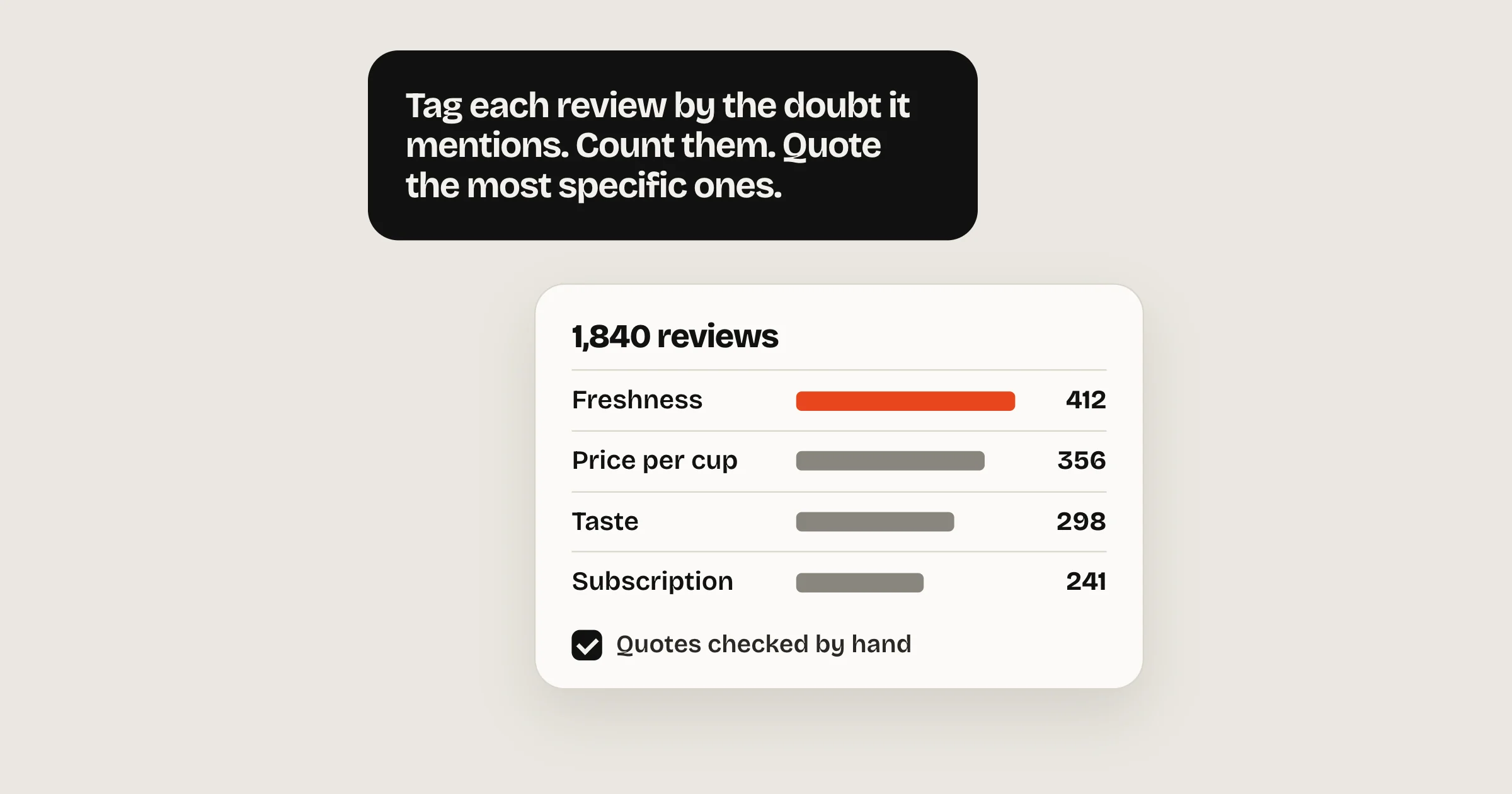
We export everything into one file and ask a model to tag each entry by the doubt or reason it mentions: freshness, price, taste, subscription worries, delivery. Then we ask for the count under each tag and the most specific quotes. The counts show which doubt comes up most, and that’s the one the next brief answers first.
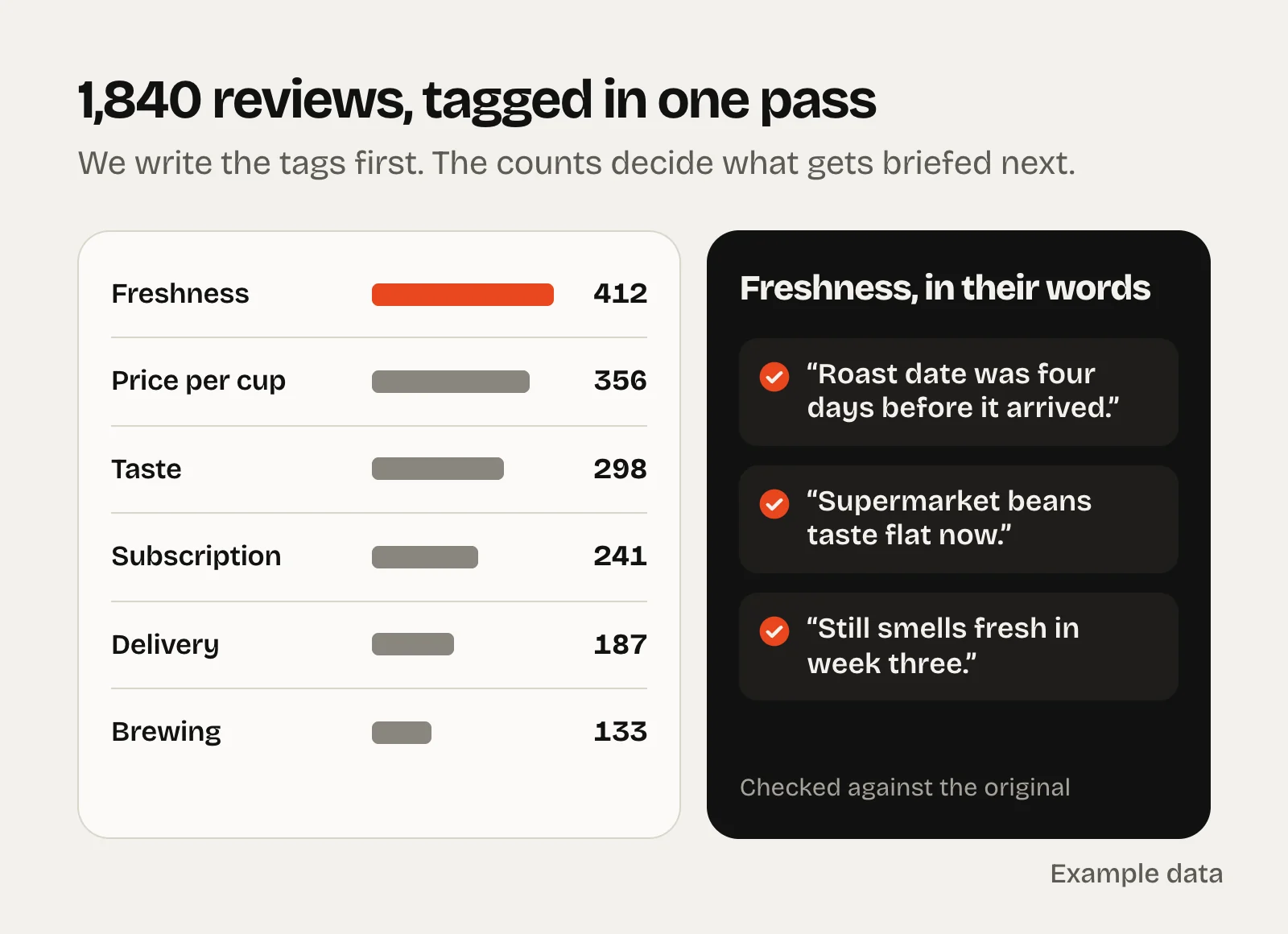
Two rules keep it honest. Every quote that goes into an ad gets checked against the original review word for word, because models paraphrase and sometimes invent. And we write the tag list before the model sees the data, so it sorts reviews into the questions we care about rather than the themes it finds easiest.
The performance side is simple. Each new angle goes into its own ad next to the current best ad, and we judge it on cost per purchase once both have enough purchases to compare. The counts set the order we test in, and cost per purchase picks the winner. There’s more on turning customer language into angles in hooks and angles.
2. Drafting variations of a line that already works
Once a video has proved itself, the cheapest new creative is a new opening on the same body. AI is quick at this. We give it the script, the angle and three openings that have worked before, and ask for twenty first lines. Most are unusable. Three or four say something genuinely different, and those are the ones we film or cut.
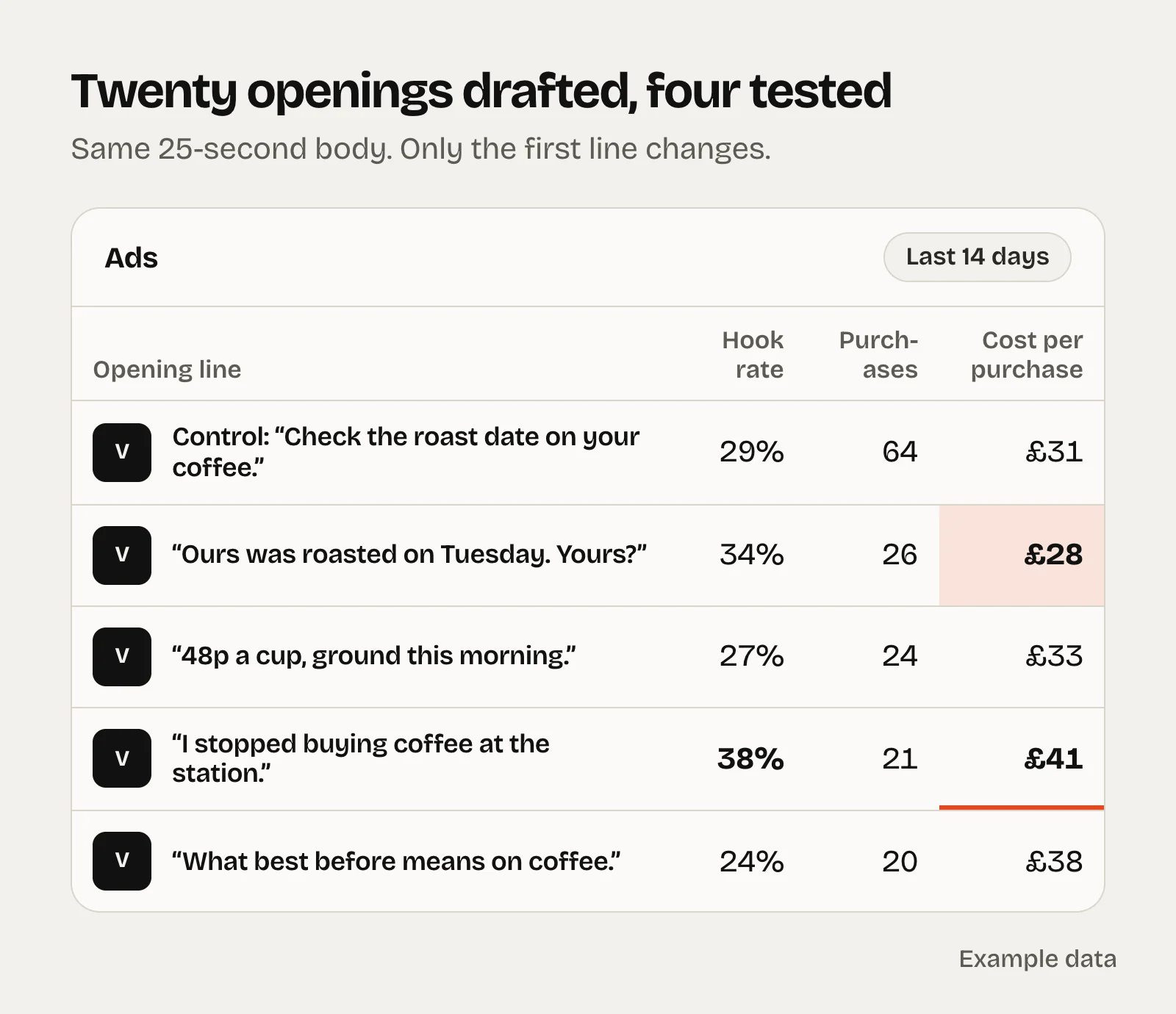
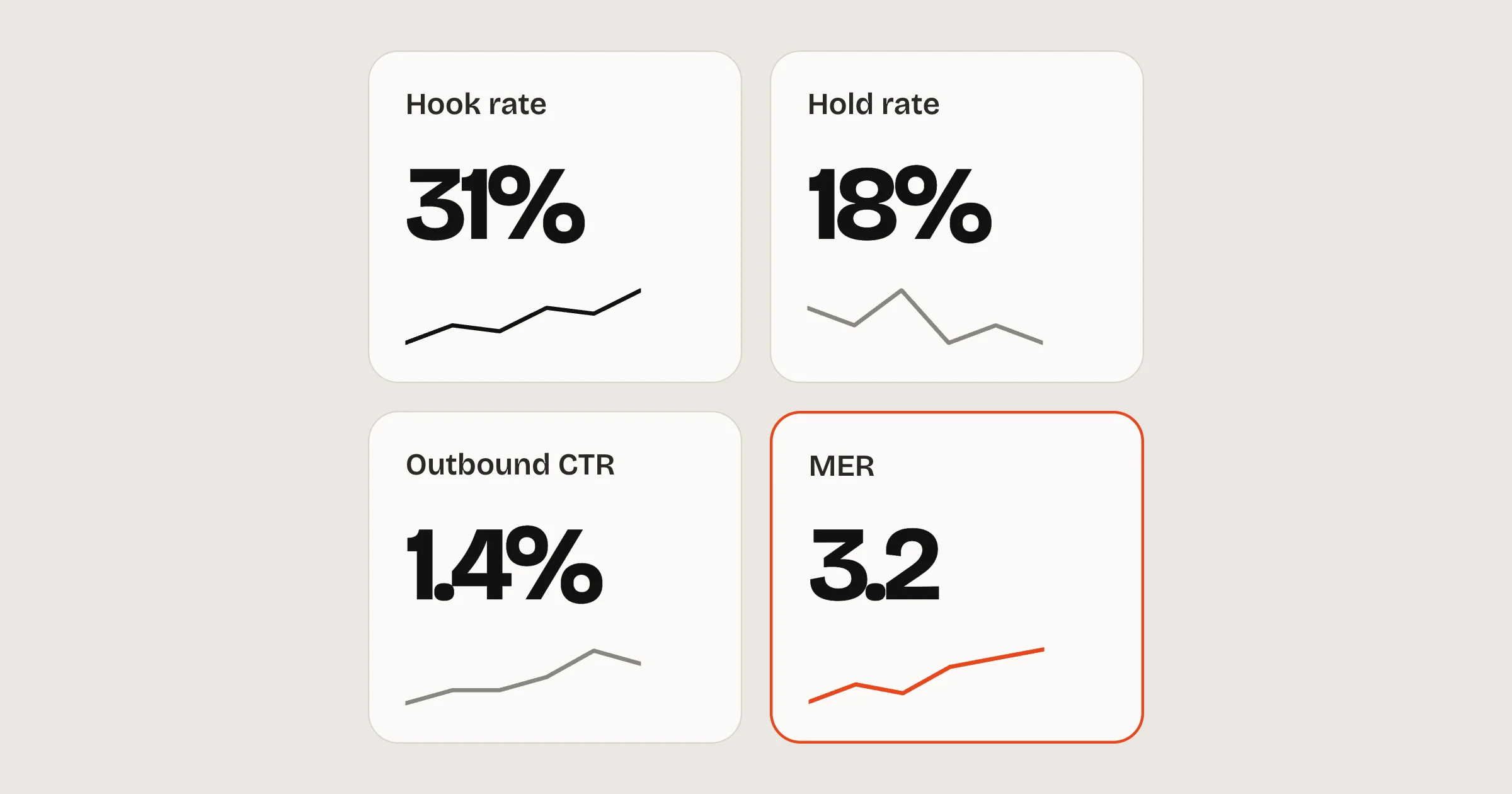
We test the openings on the same body in one ad set, read hook rate after a few days to see which first lines hold attention, then judge on cost per purchase once each version has around twenty purchases. A high hook rate on its own only tells you more people watched the first three seconds.
These are iterations, and Meta treats them that way. Its own guidance says that when ads look too similar, its system may not recognise them as different and can show them to the same people. A new opening helps a winning video last longer, but Meta may show it to much the same people as the original.
3. Resizing for every placement
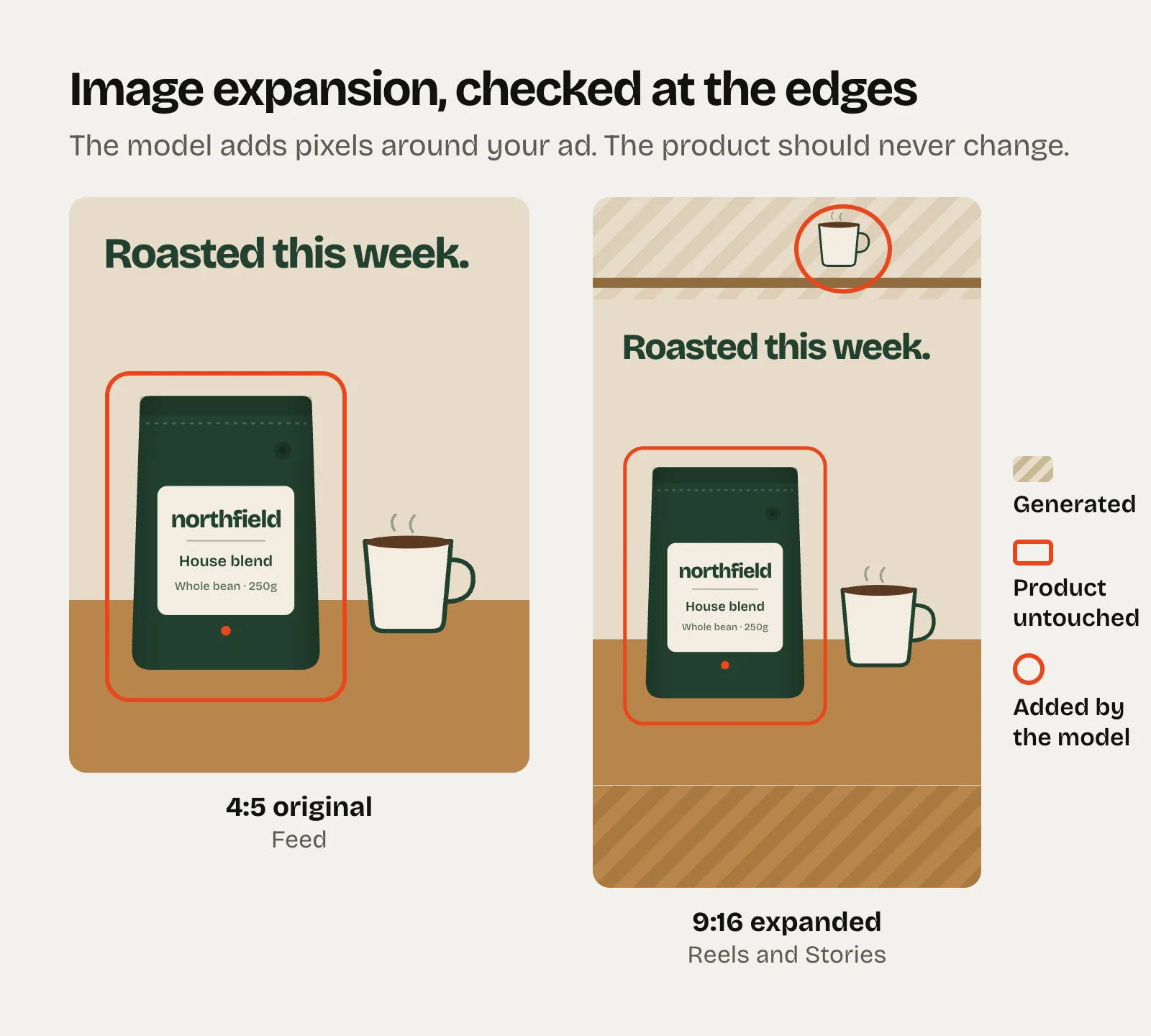
Most brands shoot or design for one shape and crop for the rest. Meta’s image expansion uses generative AI to add pixels around an image, so a 4:5 static can fill a 9:16 Reels or Stories slot without a designer resizing it.
We check every expanded version before it runs. The model invents whatever sits beyond the original edges, and that’s where odd things appear: an extra cup on the counter, a second hand, a shelf that bends. If the product sits close to an edge, we resize by hand.
To judge it, break results down by placement. If Reels and Stories bring purchases at a similar cost to Feed, the expansion is doing its job. If they bring clicks and few orders, a proper vertical edit is worth making.
4. First drafts of briefs and scripts
A blank page is slow. We ask a model for a first draft of a brief from our notes: the angle, the checked quotes, the format and the offer. It gives us structure and a few lines worth keeping. Then a person rewrites it, because AI scripts drift towards the same phrases, the same three-beat rhythm and the same tidy ending.
Viewers notice. In a NielsenIQ study of more than 2,000 people, viewers spotted most AI-generated ads and rated them more annoying, boring and confusing than conventional ads, and even the well-made ones showed weaker memory activation. A Taboola study run with academics from Columbia, Harvard and others, across more than 500 million impressions, found AI ads matched human-made ones on clicks overall, while ads that people saw as AI-made did worse. So we keep the draft’s structure and write the lines ourselves.
5. Choosing the angle stays with us
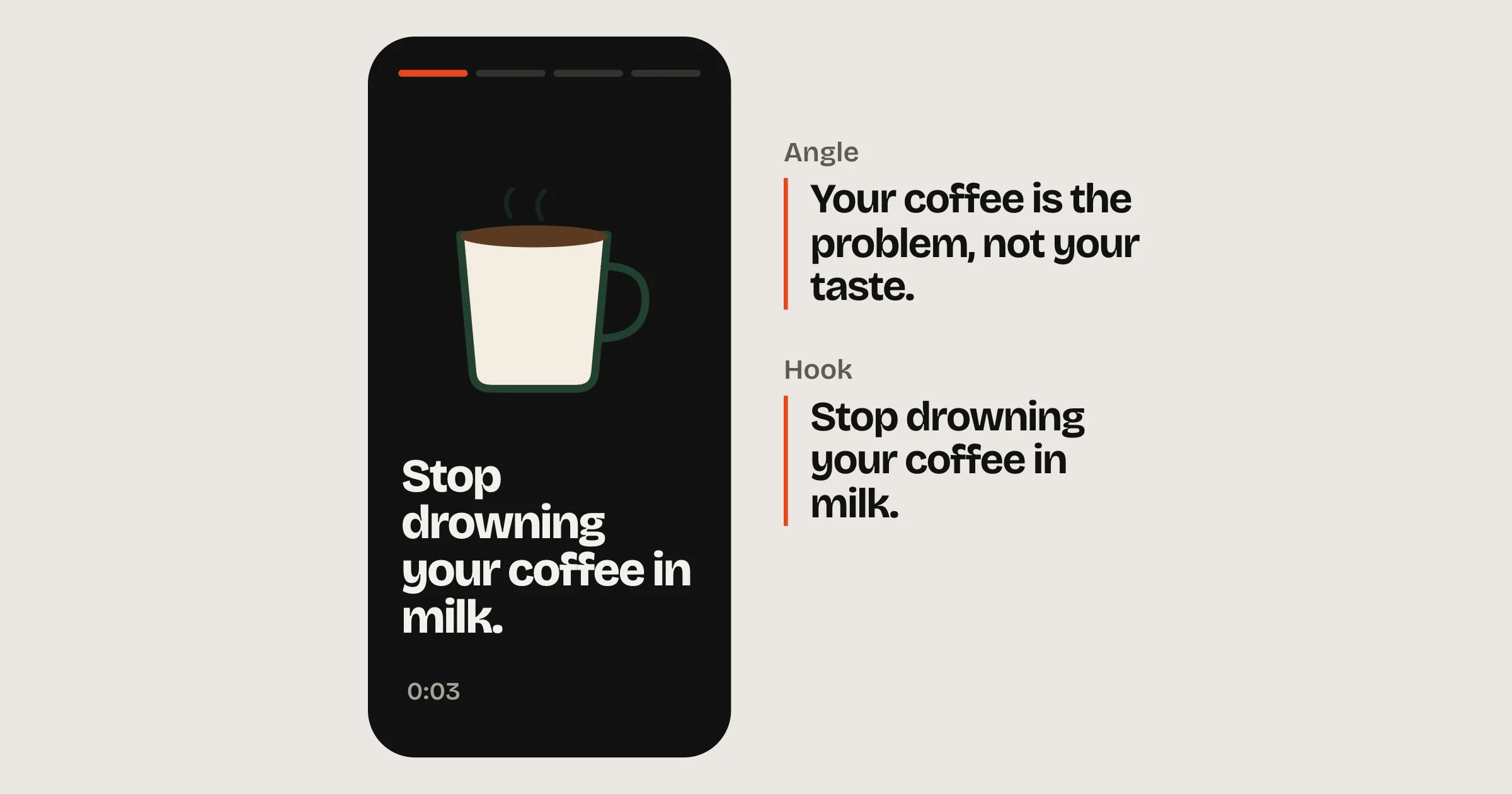
Ask a model for angles for a coffee subscription and you get the obvious ones: fresher beans, café taste for less, never run out. They’re an average of what’s already been written, which is also roughly what your competitors are running.
That costs more now than it used to. Meta’s ad retrieval system, Andromeda, narrows tens of millions of candidate ads down to a few thousand for each person, and Meta says ads that look too similar may not be recognised as different and can end up shown to the same audiences. Twenty AI variations of one idea give that system one idea to work with.
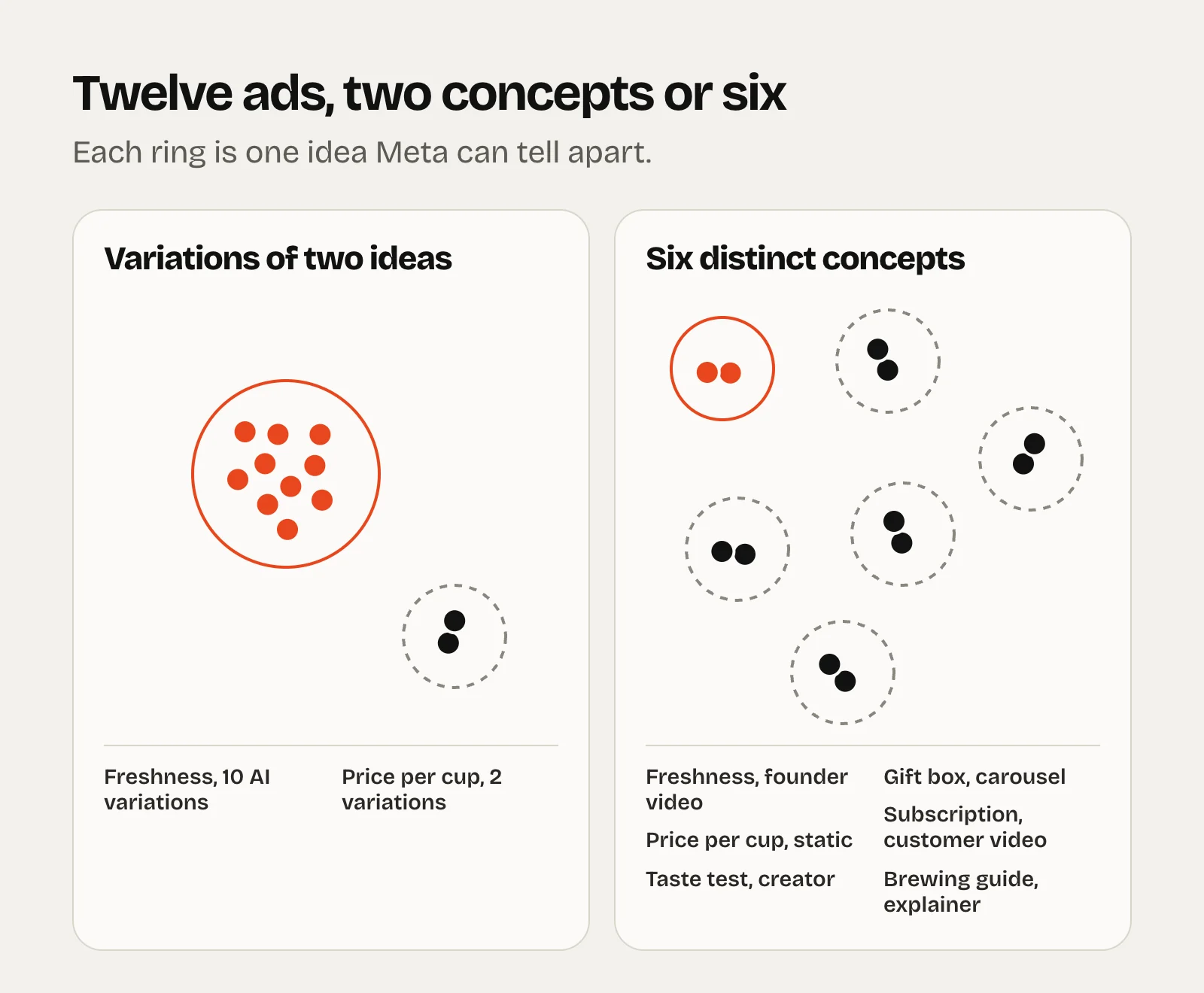
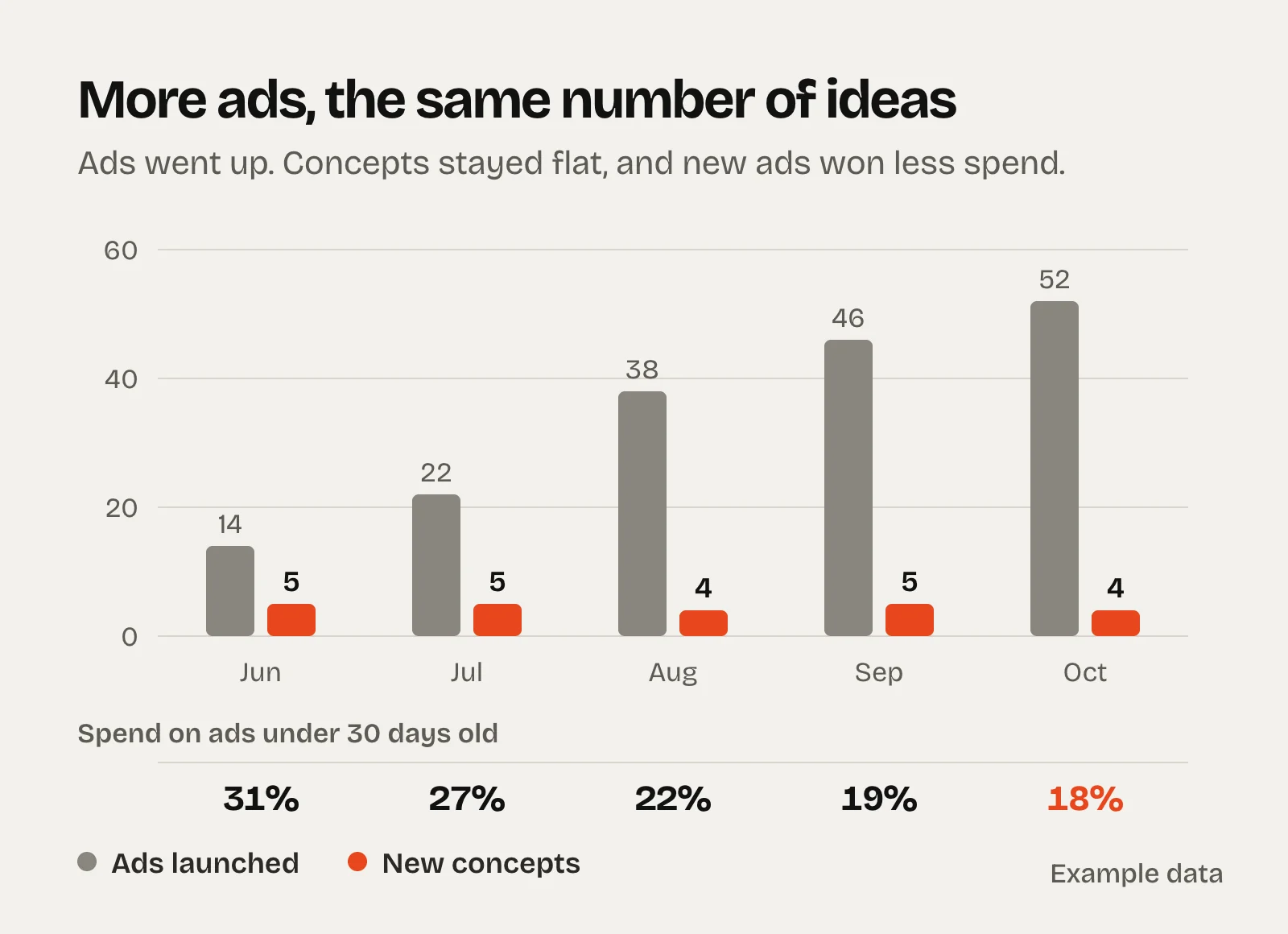
So the angle comes from the review work above, from the brand’s own team and from what we see running in the Ad Library, and a person picks it. We count concepts rather than ads, and we track the share of spend going to concepts launched in the last month. If that share falls while the number of ads rises, the account is producing volume without new ideas.
6. Product shots stay real
Image models redraw what they’re shown. Ask one to put your pouch on a kitchen counter and it will often change the label, the colour, the size or the text on the pack. In a feed that looks like a small detail. On the doorstep it’s a customer who received something different from the ad.
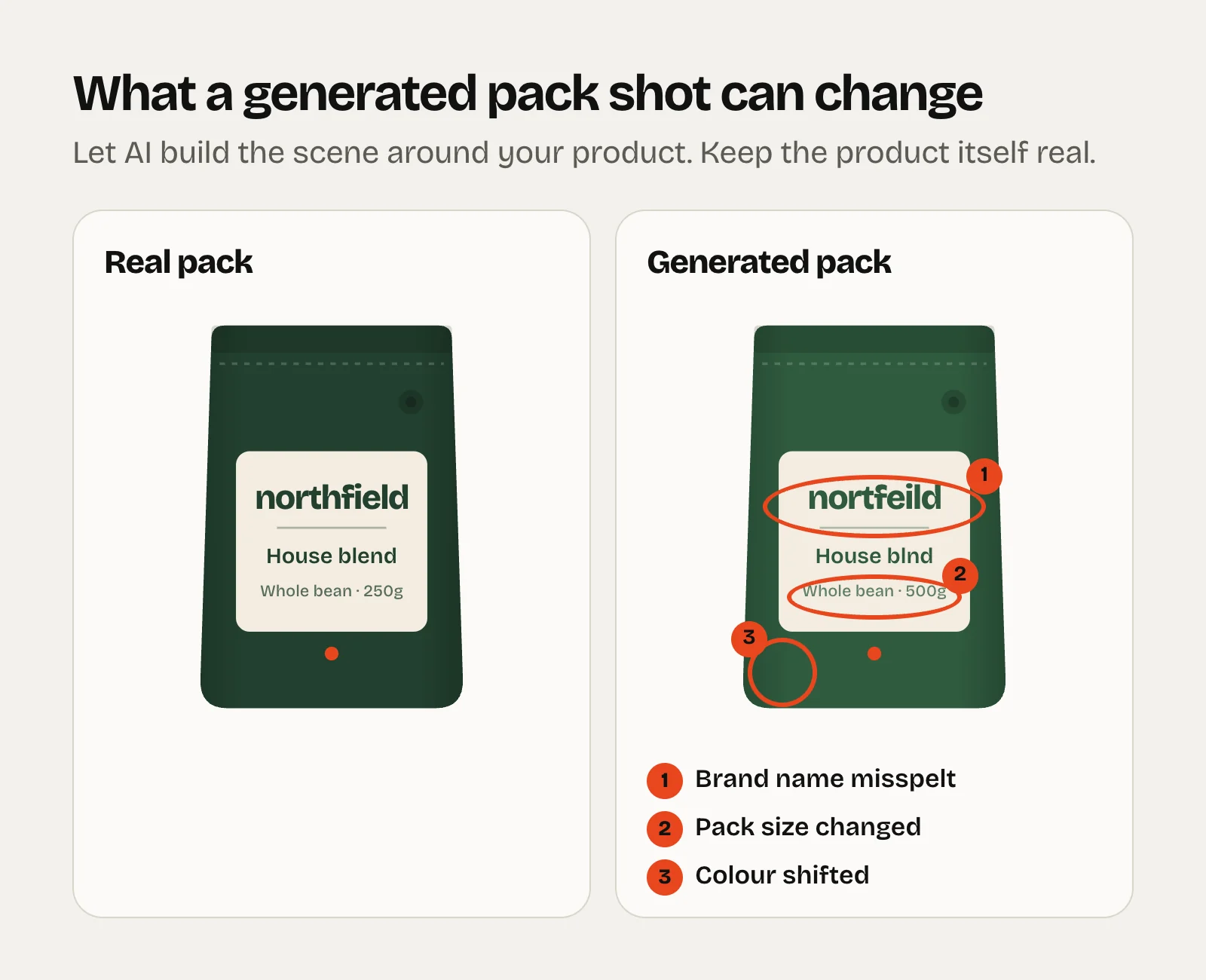
The rules don’t change because a model made the image. The ASA has said its existing rules apply however content is generated, and that an AI image showing a product’s effect in a way that doesn’t match real results is likely to mislead, with or without a note saying AI was used. Meta also labels ads whose images or video were created or significantly edited with its generative AI tools, and shows the label next to “Sponsored” when they include an AI-generated photorealistic person.
Our rule: the product in an ad is a real photo or real footage. AI can build or extend the scene around it, and the pack, the size and any result shown stay real. If you test generated backgrounds, read the comments and return reasons alongside cost per purchase, because a misleading image tends to show up there first.
7. Real people, not synthetic customers
AI avatar tools can now deliver a script to camera that passes for a creator video at a glance. We don’t use them to play customers. A made-up person saying they use a product is an invented testimonial, and the research above suggests people trust an ad less once it reads as AI.
The people in our ads are real customers, creators who have used the product, or the founder. AI helps around them: transcribing hours of creator footage, finding the strongest thirty seconds, drafting on-screen captions. We judge those ads like any testimonial ad, on cost per purchase and on whether order value holds up. More in testimonial ads that sell.
8. Meta’s built-in AI: what we switch on
Advantage+ creative bundles Meta’s AI enhancements: generated headlines and primary text, image expansion, background generation, motion on static images, music and more. Several can be switched on by default when you create a new ad, so the first job is knowing which ones are running in your account.
Meta’s own example for background generation is a 7% lift in link clicks for one brand. Clicks are the easy part, and they say little about orders. So we test each enhancement on its own with an A/B test: the same ad with the feature on and off, budget split evenly, run until both sides have enough purchases to compare, and judged on cost per purchase from the store’s own orders.
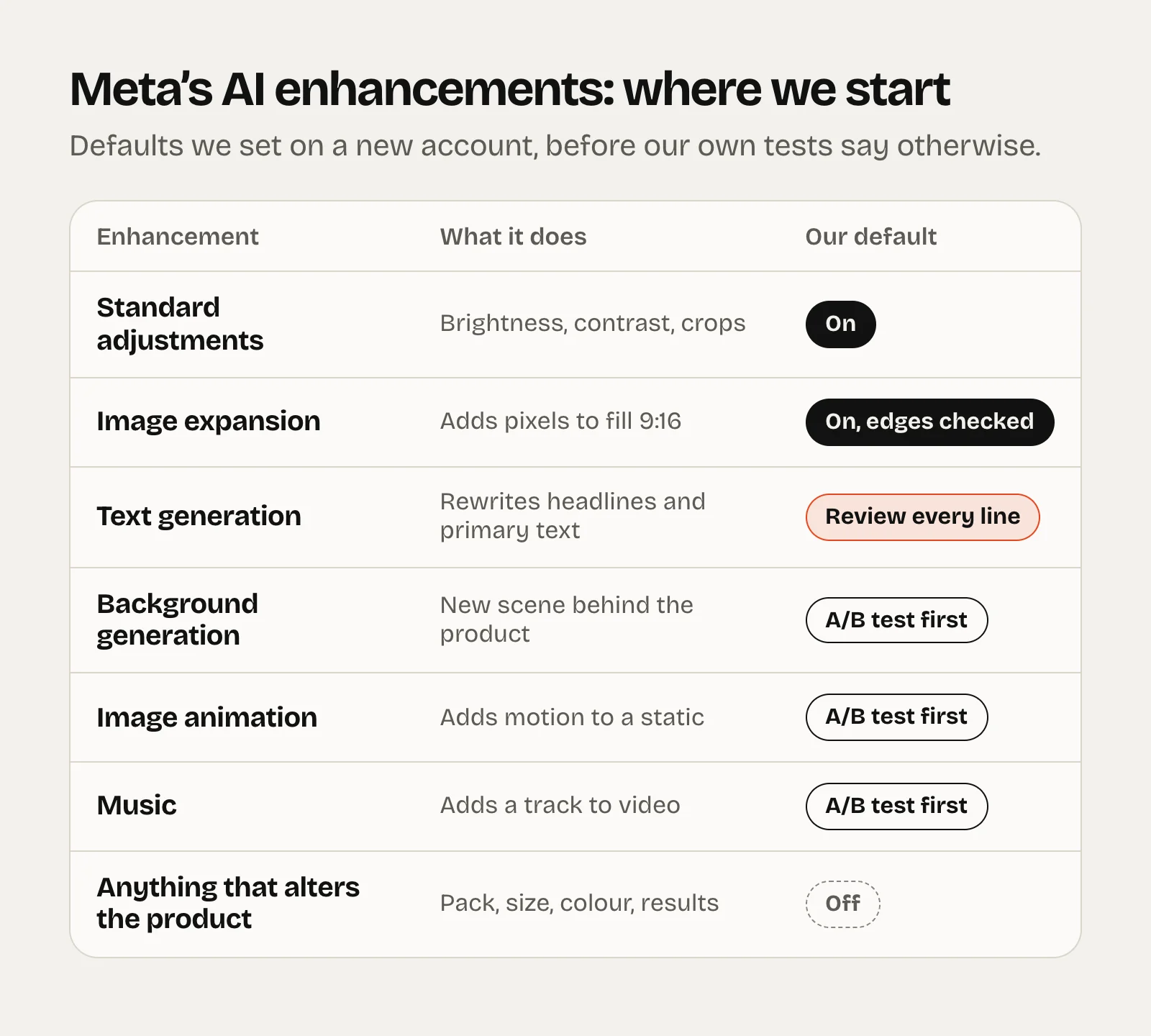
Text generation needs the closest eye. It writes from your existing ad copy, so we read every generated line before it runs and look for anything that changes what the ad promises, like “up to 30% off” becoming “30% off” or a condition dropped from an offer.
A week of creative, with AI in it
This is how a normal week runs in an account where we launch new creative weekly. AI does the reading, sorting and drafting. Choosing, checking and judging stay with people.
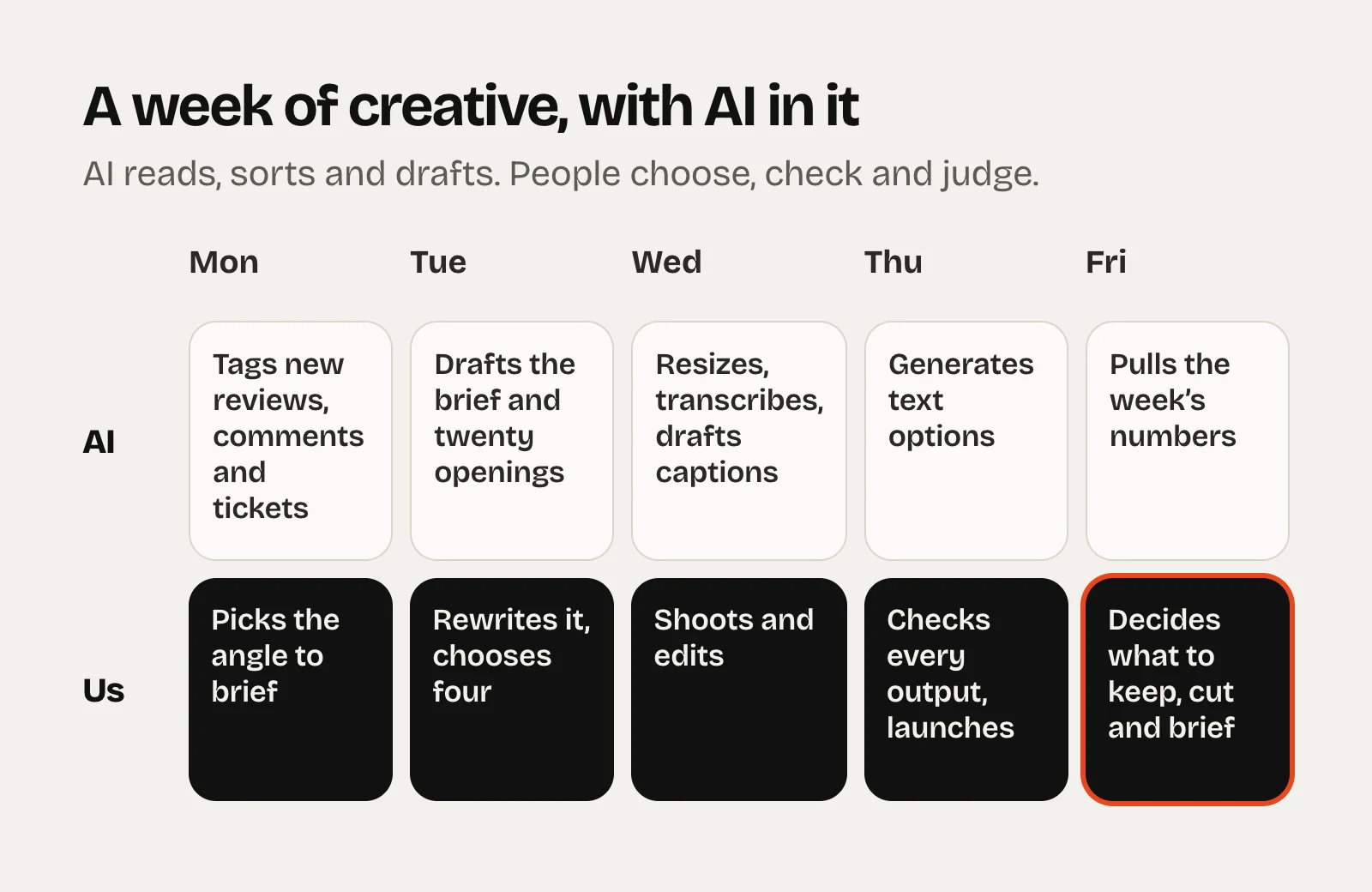
Meta’s guidance points the same way: launch new ads every week and review the creative brief with the buying and creative teams weekly. AI makes the volume easier to produce. The weekly review is where the volume turns into decisions.
How to tell if AI is helping
Three numbers show whether AI is making the creative better or only making more of it:
- Concepts launched per month, next to ads launched. If ads go up and concepts stay flat, you’ve bought volume.
- Share of spend on ads launched in the last 30 days. Meta moves budget to new ads when they perform. If new ads can’t win spend, they aren’t adding much.
- Cost per purchase of new concepts against the account’s best ads. This is the one that decides what you make next month.
If you want one thing to try this week, export the last six months of reviews, write your own list of the doubts a buyer might have, and let a model tag the reviews against it. Check the quotes, then brief the most common doubt as a new concept and test it against your best ad.